













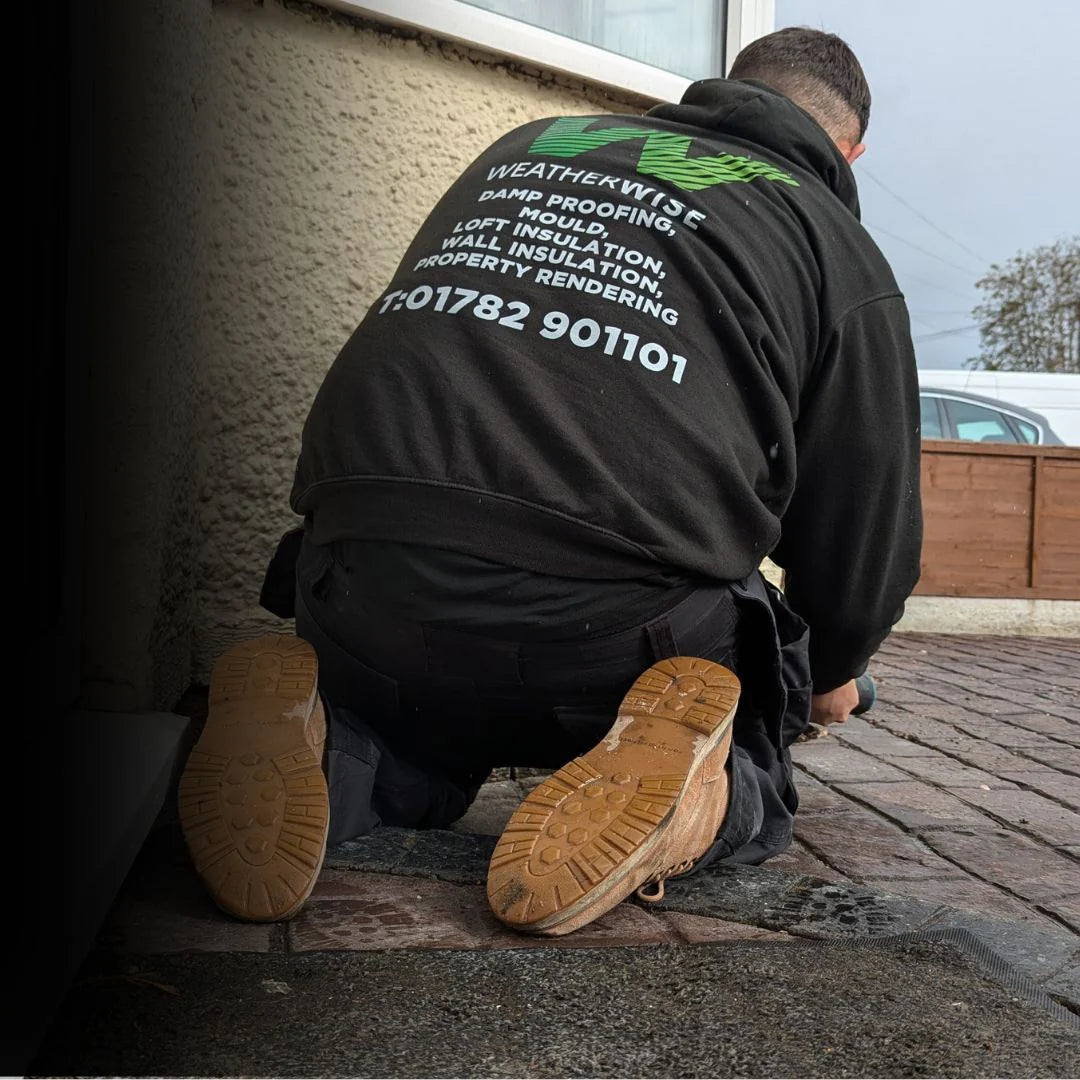

If there is a damp patch on an inside wall and no gutter, window or roof to blame, look for the holes. Boiler flues, extractor vents, gas and water pipes, cables and outside taps all pass through the outer wall, and the gap around any of them can let rain in or hold moisture against the brick. Most of these gaps are small and easy to put right. The trick is knowing to look for them. Most people in Wigan check the window and the bottom of the wall first, and miss the small hole drilled through the brickwork at exactly the height of the stain.
This guide explains how a hole in an outside wall can cause damp, which holes are the usual suspects, how to tell them from condensation and other causes, and what a proper repair involves.
🕳️ Can A Small Hole In An Outside Wall Really Let Damp In?
Yes, it can, and the size of the hole is not the point. A sleeve for a pipe might be only 25 millimetres across, but it sits in a wall that is taking rain on every wet day. If the sealing around it has cracked, shrunk or never been done properly, that small gap is a door for water.
🌧️ Why does a gap matter more than its size?
Brick and mortar are not waterproof. They soak up some rain and dry out again. A wall stays sound as long as it dries faster than it gets wet. A gap changes that in one spot: rain is driven straight into the opening, runs into the masonry around it and keeps that patch wet far longer than the rest of the wall.
💨 What does wind-driven rain do?
In an ordinary shower, rain runs down the face of the wall and drips off. In wind, rain hits the wall sideways and pushes into any joint, crack or hole. The faces of a house that take the most weather are the ones to watch. A penetration on a windward wall works harder than the same one on a sheltered side.
🏠 What Holes Go Through The Walls Of A Typical Wigan Home?
Older brick terraces and interwar semis were built with very few holes in the outer wall. Over the decades, more have been added. A modern home usually has a good handful of them. The common ones are:
- a boiler flue or vent terminal
- an extractor fan duct for the bathroom or kitchen
- a tumble dryer vent
- a gas pipe and meter box connection
- a water supply pipe or an outside tap
- an overflow or condensate pipe from a boiler or cistern
- cables for power, phone, broadband, an alarm or a satellite dish
- a hole for an air brick, a vent or a security light cable
Each one is a place where the wall has been cut through and then closed up again by someone. Whether it was closed up well decides whether it leaks. If a damp patch lines up with one of these, you have your first lead.
🔥 Can A Boiler Flue Let Damp Into The Wall Around It?
It can. A flue goes through the wall in a sleeve or duct, and the gap between the pipe and the brick is usually filled with mortar or sealant. Heat and cold make the pipe expand and shrink, and over the years the filling can crack and pull away from the pipe.
🔍 What does flue damp look like?
You usually see a stain on the inside wall at the same height as the flue, and often directly behind it. It may be a brown ring, a flaking patch of paint or a soft area of plaster. The stain tends to get worse after wind and rain from the side the flue faces.
⚠️ Who should fix a flue?
The gap around the flue can be resealed from outside, but the flue itself is a job for a Gas Safe registered engineer. Never pack, block or alter the flue opening yourself. If you think rain is getting in around a boiler flue, a gas engineer should check it, and the wall can then be repaired around it.
💨 What About Extractor Fan And Tumble Dryer Vents?
Vents are two problems in one. First, the cover and the duct can let rain in if they are not fitted with a slight fall to the outside. Second, they carry warm, wet air outwards, and that air can turn to water inside a cold duct and run back.
🚿 How does a duct cause a stain on the ceiling or wall?
If the duct slopes the wrong way, water that forms inside it runs back towards the fan and drips from the grille. That looks like a leak from the wall, but it is condensation inside the duct. A duct with a small fall to the outside, and an outlet with a flap or cowl that closes, keeps both rain and condensation out.
🧱 What about the hole in the brick?
A vent hole cut in a hurry often leaves ragged brickwork and a loose fill of mortar. That is a path for rain to the inner leaf of the wall. Neat sealing around the duct on the outside, and a neat finish on the inside, are what keep it dry.
🔧 How Do Water And Gas Pipes Let Damp Through?
Pipes that come through the wall do so in a sleeve, or in a hole cut slightly larger than the pipe. The pipe moves a little with temperature changes and with the flow of water, and the filling around it slowly lets go.
💧 Can a pipe lead rain along itself into the house?
Yes. Water will follow a surface. Rain that hits a pipe above the hole can run down the pipe and into the gap. Moisture can also creep along the outside of a pipe by capillary action, the same pull that draws water into a sugar cube. A neat drip loop, where the pipe or cable dips down below the hole and then rises to it, makes the water drip off at the lowest point rather than carry on in.
🚰 What if the pipe itself is leaking?
Sometimes the damp is a plumbing fault and not a gap in the wall. A weeping joint close to the wall will give you a wet patch that looks just like a weather problem. A damp patch that does not change with the weather, or one that gets worse when a tap or the heating is on, points to the pipe. A plumber is the right person to check that.
📡 Do Cables, Satellite Dishes And Aerials Cause Damp?
They can. Satellite dish cables are one of the most common causes of a small, stubborn damp spot, because the hole is often drilled by an installer in a hurry, at an angle, and sealed with a dab of sealant.
🔌 Why are cable holes so often a problem?
A hole drilled with a slight upward slope towards the inside lets rain run straight in. Cable entries are also often filled with a small amount of sealant that was never meant to last for years in sun, frost and rain. When it cracks, the hole opens up again. A hole drilled with a slight downward slope towards the outside, with a drip loop in the cable and a sleeve sealed at both ends, is much more weatherproof.
🛰️ What about the dish bracket itself?
The bracket is fixed to the wall with several bolts. Each bolt hole is a small penetration of its own. If a bolt loosens or the sealant around it fails, rain gets into the masonry behind the bracket and the damp can show up some distance away on the inside.
🚰 Can An Outside Tap Or Overflow Pipe Soak One Spot?
Yes, and this one is easy to miss because the water is often on the outside of the wall, not coming through a hole at all.
💦 How does an outside tap cause damp?
A dripping tap or hose connection puts a small, steady amount of water onto the same patch of wall. Brick can take in a surprising amount over weeks. The wall at that spot stays wet, and the damp can reach the plaster inside.
🚽 What about overflow and condensate pipes?
A boiler condensate pipe, a cistern overflow or a washing machine waste pipe may all discharge near the wall. If the pipe is cracked, blocked or pointing at the wall, a steady trickle ends up in one place. A wet, green or stained patch directly below an overflow is a clue worth following.
🧱 Why Does Failed Mortar Or Sealant Around A Sleeve Matter?
The sleeve or hole is only as good as what seals it. There are two weak points.
🏗️ What happens to the mortar?
Mortar around a pipe is often a patch rather than part of the original wall. It can shrink as it dries, leaving a hairline gap, and it can crack when the pipe moves. Water follows the gap into the wall.
🧴 What happens to the sealant?
Exterior sealant ages. Sunlight, frost and movement make it harden and split. A bead that looked fine five years ago can have pulled away from one side. The wrong type of sealant, such as one meant for indoor use, may fail much sooner. Sealant also needs a firm base. If it has been squeezed into a large gap without a backing, it often fails early.
🌧️ How Does Water Travel Along A Pipe Or Cable Into The House?
Water does not always come straight through the gap. It can travel.
📏 What is tracking?
Water that gets into the wall can run along a pipe, a cable or a timber and appear somewhere else. A stain on the inside of the wall may be a little above or below the hole, or to one side. The pipe or cable acts like a wick.
🪢 What is a drip loop and why does it help?
A drip loop is a downward curve in a cable or a pipe just before it enters the wall. Water that runs down the cable gathers at the lowest point and falls off, instead of carrying on to the hole. It costs nothing to put in and it stops a lot of problems. If a cable runs straight into a hole from above, that is worth fixing.
🌡️ Could A Cold Pipe Or Sleeve Cause Condensation That Looks Like A Leak?
Yes, and it is a very common mix-up. A metal pipe, a metal sleeve or a vent duct that runs through the wall carries the outside cold to the inside. Warm, damp air in the room meets that cold surface, and water forms on it.
💧 What does this look like?
You see beads of water or a damp ring on or around the pipe, usually in cold weather and more in winter than in summer. Black mould may start to grow on the plaster around it. The pipe may feel cold to the touch. It looks like a leak, but the wall itself may be dry and nothing is coming through from outside.
📊 How do you tell it from a leak?
Condensation tends to appear on cold mornings and fade by the afternoon. It is worst in rooms where steam builds up, such as kitchens and bathrooms. A leak from outside is linked to rain and wind, and the patch often stays damp for days after a wet spell. If a damp ring around a pipe goes and returns with the heating, condensation is the likelier cause. Our guide to condensation explains how moisture builds up, and the Articles guide to condensation on pipes covers pipes in particular.
🔍 How Can You Tell Which Cause You Have?
You can narrow it down without opening anything up. Look at four things: the timing, the position, the pattern and the feel.
⏱️ What does the timing tell you?
- After rain, especially with wind: a gap or a failed seal on the outside.
- Cold mornings, better by the afternoon: condensation on a cold surface.
- Constant, whatever the weather: a plumbing leak or a tap or overflow that is always dripping.
- Only when a particular tap, shower or the heating is on: a pipe fault.
📍 What does the position tell you?
Is the stain right at the height of a pipe, vent, flue or cable? Is it directly behind it, or a short distance below? A patch that lines up with a hole is a strong lead. A patch that is nowhere near any hole probably has a different cause, such as a roof leak that shows up some distance away, or driving rain on a wall that has no obvious fault.
🎨 What does the pattern tell you?
A small ring or oval around a single point is typical of a penetration. A long band at the bottom of the wall is more likely to be something else, such as ground moisture. A damp area that spreads outwards from the hole in a fan shape usually means water is tracking from it.
✋ What does the feel tell you?
Dry the surface, wait, and see how quickly it returns. A cold wall that is clammy to the touch points towards condensation. A wall that is properly wet, soft or crumbling in one patch points towards water getting in.
🧰 What Safe Checks Can You Do Yourself?
You do not need any tools to start.
👀 What can you check from the ground?
- Walk round the outside after rain and look at each pipe, vent and cable. Is the sealant intact? Is there a visible gap, or a dark wet patch on the brick below?
- Look for a drip loop. Does the cable or pipe dip before it goes into the wall?
- Check the outside tap and any overflow pipe for drips.
- Look at the mortar round each hole. Is it crumbling or cracked?
🏠 What can you check inside?
- Mark the edge of the stain with a pencil and a date, so you can see whether it grows.
- Note the weather and whether the heating was on when it looked worst.
- Check the back of the cupboard, the boiler cover or any boxing-in around the pipe. A hole is easy to forget when it is hidden.
⛔ What should you not do?
Do not climb a ladder in the wet or lean out to reach a high vent. Do not seal, cover or alter a flue or a vent that carries combustion gases. And do not smother a stain with a damp-proof paint or squirt sealant into a gap without finding out where the water is coming from first. Hiding the symptom can trap moisture in the wall.
🛠️ What Does A Proper Repair Involve?
The repair depends on the cause. A good repair fixes the way water gets in and then deals with any damage.
🧴 Resealing
Old, split sealant is cut out and the gap is cleaned and dried. A backing is pushed into larger gaps so the sealant has something to grip, and a flexible exterior sealant is applied and smoothed to shed water. A thin bead is often not enough for a wide gap.
🧱 Repointing and making good the brickwork
Where the mortar has cracked or crumbled, it is raked out and repointed with a mortar that suits the brick. A hole that has been cut roughly is made good so that there is a solid, tight edge around the sleeve.
🪛 Fitting or replacing a sleeve
A pipe or cable that passes through bare brick can be given a sleeve, sealed at both ends. A sleeve sloped slightly downhill to the outside keeps water from running in.
🪢 Drip loops and slopes
Cables and pipes are re-run so they dip below the hole before they rise to it. Ducts for extractors and dryers are set with a small fall to the outside.
🌬️ Dealing with condensation
If the cause is a cold pipe or duct, the answer is different. It may be lagging or insulating the pipe, improving ventilation, or lowering the humidity in that room. Sealing a hole will not cure condensation.
🪵 Repairing the damage
Once the water is stopped, the wall is left to dry. Damaged plaster is then replaced, and any timber nearby is checked. Redecorating comes last, because new paint over a wet wall will fail.
⏱️ How Quickly Should You Act?
There is no need to panic. A small gap around a pipe is usually a straightforward fix, and a leaking seal is rarely an emergency. But it is not worth leaving for years either. Every wet spell soaks the same patch, and the longer it stays wet, the more the plaster, paint and any timber nearby suffer. A sensible approach is to note the stain, check the outside after the next rain, and book a survey if you cannot find the cause or if the patch keeps coming back.
🧪 Why Can A Damp Meter Mislead You Here?
A damp meter is a useful tool, but it needs reading carefully. A pipe or a cable in the wall can set off a high reading on its own, because metal affects a simple meter. Salts left in plaster by an old leak can also make a wall read wet when it is only damp-prone. That is why a surveyor does not rely on a single number. They compare readings across the wall, look at where the damp sits and check the outside as well as the inside. A reading on its own tells you very little.
🪵 Can A Leaking Penetration Affect Timber Inside?
It can, if the leak goes on long enough. A pipe or a cable often enters the wall near a floor, a window board or a skirting. If water keeps running down behind them, timber in contact with a wet wall can stay damp enough for wet rot to start. This does not happen quickly, and many leaks never reach the timber. But a soft skirting board or a floor that feels spongy near a pipe entry deserves a look, rather than a coat of paint. Our post on driving rain and damp and our penetrating damp page both explain how water that gets into a wall can reach other parts of the house.
🧑🔧 Who Should Fix What?
Different trades handle different parts of the job, and it helps to know which is which.
- A Gas Safe registered engineer looks after boiler flues and gas pipes.
- A plumber deals with a leaking pipe, tap or overflow.
- A satellite or aerial installer or an electrician can re-run a cable properly.
- A builder or bricklayer repoints and makes good the brickwork.
- A damp surveyor works out where the water is coming from and where it has gone, and whether the wall, plaster and timber need attention.
Weather Wise Solutions diagnoses the damp. If the answer is a plumbing, gas or building job, we say so plainly, so you are not paying for the wrong repair.
🔎 How Do We Investigate Damp Around A Hole In The Wall?
A survey starts with a conversation: where the damp is, when it appears and what has changed. Then we look at the whole picture. We take moisture readings across the wall and compare them with a dry reference area. We check the outside of the wall at the same point, including the sealing, the pointing, the gutters and the ground level. We look at whether there is a pipe, flue or cable behind the stain. And we consider the alternatives, because a wet patch by a pipe is not always a leak.
Surveys are free, and you can book one through our Wigan area page or the contact page.
🎓 Why Do Qualifications Matter For This Kind Of Diagnosis?
Wrong guesses are expensive. A hole in a wall that is blamed on rising damp can lead to the wrong treatment, and the stain returns. Our surveying team includes professionals holding the Certified Surveyor of Timber & Dampness in Buildings (CSTDB) qualification alongside the Level 3 Award DMCB and the City & Guilds-recognised FODCS qualification. In practice that means reading the pattern of the damp before recommending anything. You can meet the team on our qualified surveyors page.
💬 Frequently Asked Questions
❓ Can a hole for a pipe let damp in even if it looks sealed?
Yes. Sealant can look fine from a distance and still have a hairline gap on one side, or a gap behind it. Check it after rain, and look closely at the join between the sealant and the brick.
❓ Is damp around a boiler flue dangerous?
A damp stain is mainly a building problem, but the flue itself is a safety item. If you are unsure about the condition of a flue, ask a Gas Safe registered engineer to check it.
❓ Why does the patch around my pipe come and go?
If it comes and goes with the weather, rain is likely getting in. If it comes and goes with cold mornings or the heating, condensation on the cold pipe is more likely.
❓ Will sealing the hole stop the damp?
If the hole is the cause, yes, once the wall has dried out. If the real cause is condensation, a leak inside or something else, sealing will not help. That is why finding the cause comes first.
❓ Could the damp be something else entirely?
Yes. A blocked gutter, an overflowing gutter, failed pointing, rising damp or a roof leak can all give a similar stain. A hole is a good place to start, but it should not be the only place you look.
📞 Damp Around A Pipe, Flue Or Cable In Wigan?
If you have a stain you cannot explain, or a pipe that seems to be sweating, a survey will tell you what is going on.
At Weather Wise Solutions Limited, we cover Wigan and the wider Greater Manchester area. Our services include damp proofing, condensation control, mould treatment, timber treatment and ventilation.
We are members of the Damp Proofing Association, the Federation of Damp and Trust a Trader, and we are CHAS accredited and Google Guaranteed.
Book your free survey with Weather Wise Solutions through our Wigan page, on 01782 901101, or via the contact page.
✅ In Short
- A small hole can let in a lot of water, because wind pushes rain into any gap.
- Check the usual suspects: flues, vents, pipes, cables, taps and overflows.
- A stain at the height of a hole is your first lead.
- A cold pipe can sweat, and that is condensation, not a leak.
- Find the cause before you seal anything.
- Most small gaps are an easy repair once you know where they are.