













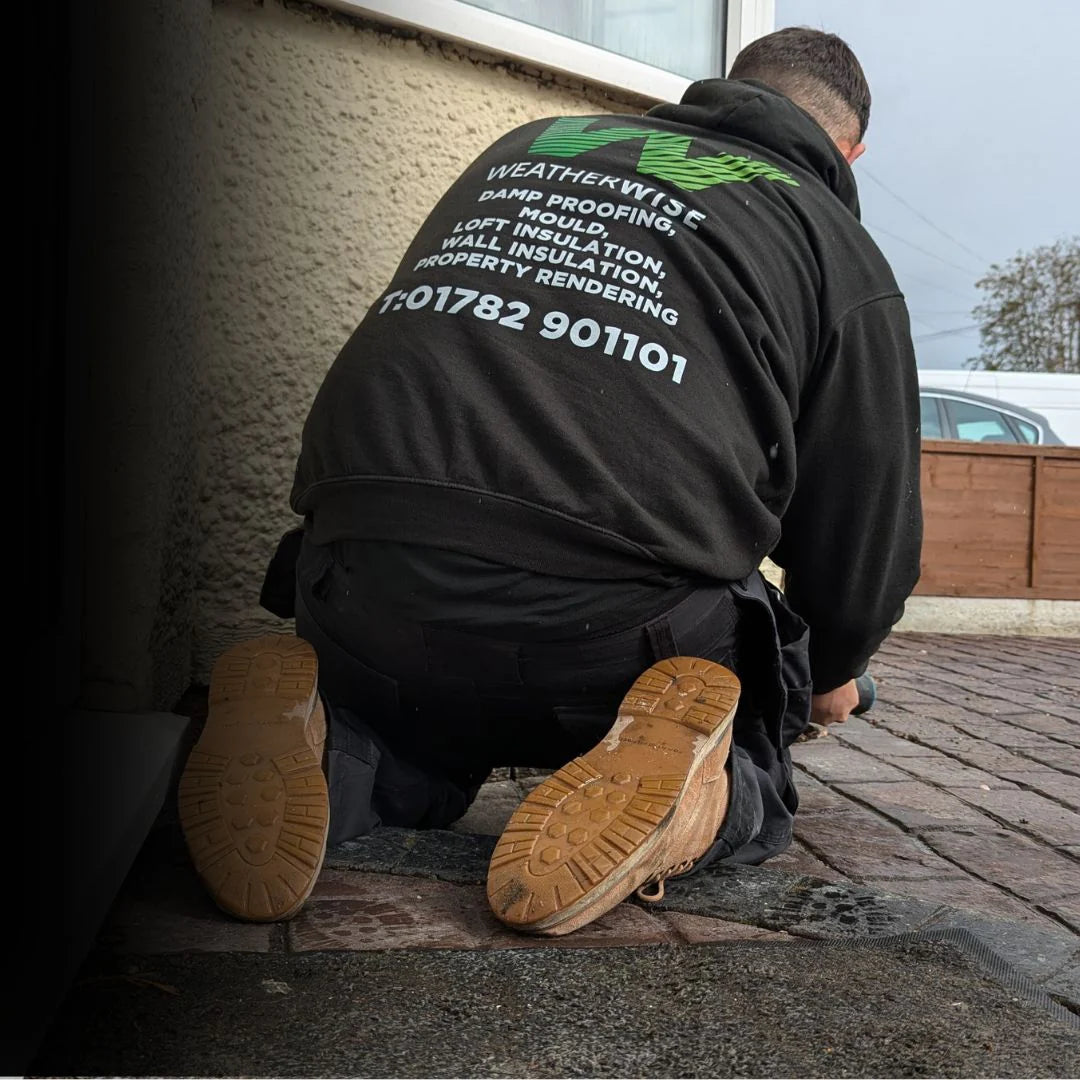

We see this regularly in Wrexham.
A homeowner calls because damp patches have appeared along the bottom of an internal wall.
Sometimes the plaster is bubbling.
Sometimes the skirting boards feel slightly soft.
Often, they’ve already been told it’s “rising damp.”
But when we step outside, the real issue becomes obvious.
The patio has been raised.
Or decorative stone has been added.
Or a driveway has been resurfaced.
And the external ground level is now sitting too high against the wall.
🧱 What Happens When Ground Levels Are Too High?
Every property should have a visible gap between the damp proof course (DPC) and the external ground level.
As a general rule, there should be approximately 150mm (two brick courses) of clearance.
When patios, soil, or paving are raised above this level, the DPC becomes bridged.
Moisture can then:
-
Track across the masonry
-
Transfer into internal plaster
-
Affect skirting boards
-
Cause salts to appear internally
The damp proof course itself may still be perfectly functional.
It’s just being bypassed.
🏡 A Typical Wrexham Scenario
We recently inspected a property where:
-
A new patio had been installed
-
Decorative gravel was banked against the wall
-
Air bricks were partially obstructed
Internally, the homeowner had:
-
Blown plaster
-
Damp readings at low level
-
Peeling paint
They had been advised to install a new damp proof course.
But the issue wasn’t failure.
It was bridging.
Lowering the external level resolved the problem without invasive internal work.
Diagnosis matters.
💧 Why Bridging Mimics Rising Damp
When moisture bypasses the DPC, it presents very similarly to rising damp:
-
Low-level staining
-
Skirting decay
-
Salt contamination
-
Damp meter readings at the base of the wall
But modern damp diagnosis requires:
-
External inspection
-
Ground level assessment
-
Checking for visible DPC
-
Identifying physical bridging
Installing a new silicone based injection without correcting external levels will not solve the issue.
Moisture will continue to bypass the system.
🌬️ Don’t Forget Subfloor Ventilation
Raised ground levels often block or partially cover air bricks.
This restricts subfloor airflow.
Reduced airflow can increase:
-
Joist end moisture
-
Timber decay risk
-
Internal humidity imbalance
What looks like one problem can often create several.
That’s why we assess the whole building envelope.
🔍 How We Investigate High Ground Level Damp in Wrexham
Our inspection includes:
-
Measuring DPC clearance
-
Checking external finishes and patio heights
-
Assessing air brick visibility
-
Moisture profiling internally
-
Identifying salt contamination risk
In many cases, correcting external levels is far more effective than internal damp proofing works.
And it avoids unnecessary disruption.
👷 Professional Standards & Independent Guidance
Weather Wise Solutions are proud members of:
🔗 Federation of Damp – https://federationofdamp.co.uk/
🔗 Damp Proofing Association – https://www.dampproofingassociation.co.uk/
Our specialists hold CPD qualifications in Dampness in Buildings and follow a diagnostic-first approach.
You can view independent reviews here:
🔗 TrustATrader – https://www.trustatrader.com/traders/weather-wise-solutions-limited-damp-surveyor-newcastle-under-lyme
🔗 Checkatrade – https://www.checkatrade.com/trades/weatherwisesolutionslimited
If you’ve noticed damp appearing after patio installation in Wrexham, the cause may not be rising damp at all.
It may simply be high external ground levels bridging your damp proof course.
Fix the external cause.
Protect the internal fabric.
Prevent recurrence.
📍 Book a Free Survey for your home here:
https://weatherwiseuk.co.uk/pages/contact