













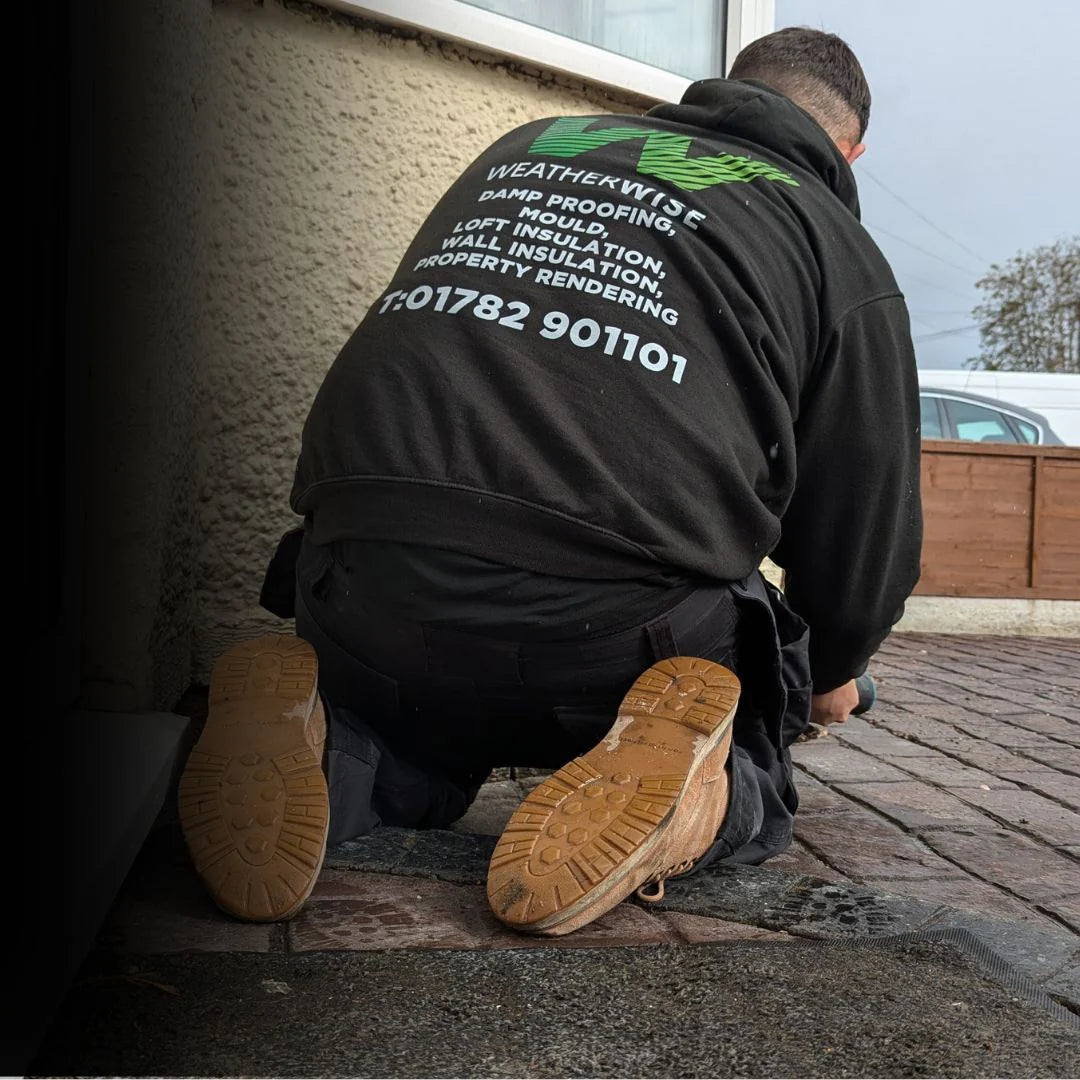

A brown patch or a tide mark above a window or door is easy to blame on the window. Often the window is fine. The fault is the lintel over it, or the tray that should sit above that lintel, and the water arrives at the inside face of the wall a little way above the opening. If you're in Crewe and you've noticed a stain, flaking paint or a crack above a frame, this post explains what a lintel does, how it fails and how to tell it from the other causes.
🧱 What Does A Lintel Actually Do?
A lintel is the beam that carries the brickwork over a window or door opening. Without it, the wall above would have nothing to rest on. It spans the gap and passes the weight down to the brickwork on either side.
It also has a second job that people forget. Rain runs down the face of a wall, and some of it gets into the cavity. In a cavity wall, a small waterproof strip called a cavity tray sits on top of the lintel and catches that water. It slopes towards the outside, and small gaps in the brickwork called weep holes let the water out. So the lintel carries the load and the tray carries the water away.
What are lintels made of?
It depends on the age of the house.
- Older homes often have a brick arch or a stone lintel over the opening, sometimes with a timber lintel hidden behind the brick on the inside.
- Houses from the middle of the last century often have precast concrete lintels.
- Many later homes have steel lintels, either a simple angle or a box section, sometimes galvanised and sometimes only painted.
Each type fails in its own way, which is why it helps to know what you're dealing with.
🏠 What Do Homes In Crewe Usually Have Over Their Windows?
Crewe grew up around the railway, and a lot of the older streets are brick terraces and semis from the Victorian and Edwardian years. Around them sit later estates from between the wars and after, then newer builds. That mix means you can find almost every lintel type in one town.
A Victorian terrace may have a shallow brick arch or a stone head over each window, and an internal timber lintel behind it. A 1930s semi often has a concrete lintel. A house from the sixties onwards is more likely to have steel. Replacement windows have been fitted to many of them over the years, and the new frame doesn't change what's sitting above it. If you want to see what a surveyor looks at on your street, our Crewe page has more on the area we cover.
🪟 How Can A Failing Lintel Let Damp In?
There are several ways, and more than one can happen at once.
Can a rusting steel lintel do it?
Yes. Steel that isn't well protected rusts, and rust takes up more space than the steel it came from. As it builds up, it pushes the brickwork above and around it apart. You may see a horizontal crack along a mortar joint just above the opening, brickwork that has lifted a little, or flaking and rust staining. Those cracks are small paths for rain.
Rust also thins the steel itself. A badly corroded lintel is a structural matter, and that's for a builder or structural engineer to judge. A surveyor can spot the signs, but we don't carry out lintel replacement.
What about a concrete lintel?
Concrete lintels contain steel reinforcement. If water reaches that steel it rusts, and the concrete cracks and flakes away from it. The underside of the lintel may show rust stains or small pieces that have dropped off. Cracked concrete lets more water in, and the process feeds itself.
Can a timber or stone lintel cause damp?
A timber lintel that stays wet can rot, and then it can settle and open up gaps above the opening. You may see a slight dip in the brickwork or a diagonal crack running up from a corner of the frame. Stone lintels are tougher but can be worn, cracked or poorly pointed along their top edge.
What if there is no tray, or the tray has failed?
This is the one people miss. The tray may never have been fitted. It may be too short, so water slips round the end. It may have been damaged when a replacement window went in, or buried in mortar that fell into the cavity. Weep holes can also be blocked with paint, mortar or a cavity fill.
When the tray doesn't do its job, water that gets into the cavity runs down onto the lintel and across to the inside leaf of the wall. It then comes out on the inside as a stain above the window, even when the lintel itself is sound.
🌧️ What Does Damp From A Lintel Look Like?
The clues are in the pattern. Look for:
- a brown or yellow stain on the wall or ceiling edge directly above the window or door, often wider than the opening
- paint that bubbles, flakes or peels in that strip
- a hairline crack running along the top of the frame, or a step crack rising from a corner
- wallpaper that lifts at the top of the opening
- a musty smell near the window that is stronger after rain
- rust staining on the outside brickwork, or a rusty line along the underside of the lintel
- a tide mark that returns after you've decorated over it
One more sign matters a lot. If the stain follows the weather, with a wet patch a day or two after heavy, wind-driven rain and a drier one after a dry spell, then water is getting in from outside.
🔍 How Do You Tell It From A Leaking Window?
This is the question most homeowners ask first, and it's a fair one. A leaking window and a failing lintel can look alike.
What points to the window?
Water from a failing window seal or sill tends to show at the sides and bottom of the frame, on the reveal or on the sill. It drips down and collects low. Our post on damp around a window that only appears when the wind blows from one direction covers that side in more detail.
What points to the lintel?
Water from the lintel or the tray above comes in at the top. The stain sits above the opening, often spreading sideways across the width of the frame and sometimes beyond it. Because it comes down through the wall, the window itself can be dry.
Can both be true at once?
Yes. An old window with a failing seal under a leaking lintel is common. That's why a survey looks at the whole opening, not just the part you can see.
🌡️ Could It Be Condensation Instead?
Possibly. The wall above a window can be colder than the rest of the room. The lintel is a harder, denser material than the brick around it, so it conducts cold more easily. That's a thermal bridge, and warm, damp air that reaches it can condense.
Condensation tends to look different. It's usually a band of black or grey mould spots along the top of the opening, with little or no staining or cracking. It's worse in cold weather and when the room is humid, and it doesn't care whether it rained yesterday. A lintel leak is the other way round: it follows the rain, not the temperature.
If you've got mould above a window and no sign of a rain pattern, our condensation page is a better starting point.
💧 Is It Just Penetrating Damp?
Penetrating damp is rain getting through the outside wall, and a lintel problem is one form of it. Other forms include failed pointing, cracked render, a broken gutter and gaps round the frame. Our penetrating damp page goes through them. A stain above a window can come from any of those, so it's sensible to rule out the easy ones before blaming the lintel.
Gutters are the usual suspect. A gutter that overflows soaks the same strip of wall each time it rains. Our post on how an overflowing gutter can cause damp inside the house shows how to spot that, and our post on damp that appears after heavy rain with no obvious leak is worth a read if you can't find a cause.
🚫 Is It Rising Damp?
Almost certainly not. Rising damp comes up from the ground and shows low on a wall, usually within the first metre, often with a wavy tide mark and white salts. A stain above a window is well out of that range. Please don't let anyone treat it as rising damp. Our rising damp page lists the signs so you can compare.
👀 What Can You Check Safely Yourself?
You don't need a ladder. Most of this you can do from the ground and from inside.
What can you do outside?
- Look up at the opening. Is the brickwork above it straight, or does it dip or bulge?
- Look for cracks. A crack along a mortar joint just above the frame, or a stepped crack rising from a corner, is worth a photo.
- Look for rust. Brown streaks or flaking along the underside of the lintel point to steel that is corroding.
- Look for weep holes. They're small gaps in the vertical joints along the course just above the lintel. On many homes you can spot one every few bricks. If there are none, or they're filled with paint or mortar, that's a clue.
- Check the gutter above. Is it dripping or overflowing onto the wall above the window?
What can you do inside?
- Mark the edge of the stain with a pencil and date it. A week or two later, see whether it has grown after rain.
- Press the paint gently. If it's soft or powdery, the wall is holding water.
- Compare the stain with the weather. Write down when it's worse.
- Look at the window itself. Are the seals sound, and is the frame dry at the sides and bottom?
Never poke at a cracked lintel, never prop it, and never try to take brickwork out above an opening. If a crack is wide, growing, or you can see sagging, ask a builder or structural engineer to look at it promptly.
🪵 What Happens To The Timber And Plaster Around It?
A wall that's wet above an opening can affect more than the paint. Plaster gets damp, salts come out and push the surface off, and timber near the head of the frame can suffer. That includes window frames, the board that holds a curtain pole, an internal timber lintel in an older house and the ends of floor joists in a first floor room.
Wet rot is the usual result where timber stays damp. Dry rot is less common, but it can start where timber is damp and the air is still. Our wood rot and woodworm page explains how to tell them apart. If timber near the opening feels soft, or you see a fluffy growth or a red dust, get it looked at.
🧑🔧 Who Fixes What?
It helps to be clear about who does which job, so you aren't waiting for the wrong person.
- A builder or structural engineer decides whether a lintel is safe, and replaces or repairs it if it isn't.
- A builder also fits or repairs cavity trays and weep holes, and repoints or repairs cracked brickwork around the opening.
- A window installer deals with a failed frame seal or a badly fitted frame.
- A gutter specialist or roofer sorts any overflow above the opening.
- A damp surveyor works out where the water went once it got in, whether the wall, plaster and timber have been affected, and what each needs.
At Weather Wise Solutions Limited we diagnose the damp and deal with the damp and timber work. We don't replace lintels. What we can do is tell you whether the stain above your window comes from the lintel, the window, the gutter, condensation or the wall itself, so the right trade fixes the right thing the first time.
🛠️ What Fixes Each Cause?
Painting over a stain is the usual first move and the wrong one. Fresh paint on a wet wall will blister, and the mark comes back through it.
What fixes a failing lintel?
If the lintel is corroded, cracked or sagging, it usually needs replacing, and that's a job for a builder with the right propping and an engineer's advice where needed. Once the new lintel is in with a proper tray and weep holes above it, the water has a way out again.
What fixes a missing or failed tray?
The builder opens the brickwork above the opening, fits a tray that extends past the ends of the lintel, and adds weep holes. It's more work than a surface repair, but a surface repair doesn't solve it.
What fixes the wall afterwards?
Once the water stops, the wall has to dry. That can take weeks. Plaster that's been wet for a long time may hold salts, and a damaged patch may need replacing. A moisture meter tells you when the wall is ready, so repair and redecorate after the readings settle, not before.
What if it turns out to be condensation?
Then it's about the moisture in the room and the cold spot over the opening: steady background heat, extraction in kitchens and bathrooms, ventilation, and keeping furniture and curtains from sealing the area. Our diagnosing damp page explains how readings help separate these causes.
⚠️ What Mistakes Make It Worse?
- Painting over the stain. It hides the problem and traps moisture.
- Filling a crack with sealant and calling it done. A smear on the surface rarely lasts, and it can trap water inside the wall.
- Blocking the weep holes. People fill them with mortar or paint to stop draughts. That stops the water getting out too.
- Treating a high stain as rising damp. It's the wrong diagnosis and the wrong treatment.
- Ignoring a growing crack. A crack that widens over a few weeks needs a professional opinion.
- Assuming one cause. A window seal, a gutter and a lintel can all be at fault on the same wall.
📆 Why Does This Show Up In Late Autumn?
Late October brings the first long run of wet and windy weather. Leaves have blocked gutters, and wind-driven rain is pushed into brickwork that dried out over the summer. Small gaps and cracks that were harmless in August start letting water through. It's also before the hard frosts, which can open a crack further.
If a stain has appeared this month, or an old one has come back, it's a good time to find out why. A short look in daylight can save a lot of repair later.
🎓 Why Does The Surveyor's Qualification Matter Here?
A stain above an opening can have several causes at once, and the wall and timber around it may or may not be affected. Sorting that out takes careful readings and a trained eye, not a guess.
Our surveying team includes professionals holding the Level 3 Award in Damp, Mould and Condensation in Buildings (L3 Award DMCB), the Certified Surveyor of Timber & Dampness in Buildings (CSTDB) qualification and the City & Guilds-recognised Federation of Damp Certified Surveyor (FODCS) qualification. The L3 Award DMCB matters where condensation and mould are part of the picture, and the CSTDB matters where timber around the opening has been wet. You can meet the team on our qualified surveyors page.
We're also members of the Damp Proofing Association, the Federation of Damp and Trust a Trader, and we're CHAS accredited and Google Guaranteed.
📋 How Do We Investigate Damp Above A Window Or Door?
When we visit a home in Crewe or anywhere else we cover, we follow the same order each time.
- We listen first. When did you first see the stain? Does it follow the weather? Has the window been replaced or the wall repointed?
- We look at the room. How it's heated and ventilated, and exactly where the stain sits.
- We take moisture readings. We map the wall above, beside and below the opening and compare it with a dry wall in the same room.
- We go outside. Brickwork, pointing, render, the lintel, weep holes, the gutter above and the frame seals.
- We check the timber that could be affected, with a probe and a meter.
- We explain what we found in plain language, and say what should be done first and by whom.
The aim is to find the cause, not just the stain. If the cause turns out to be a lintel or tray that needs a builder, we'll say so plainly, and tell you what to ask the builder to look at.
📍 Do We Cover Crewe?
Yes. We cover Crewe and the wider Cheshire area, and you can see more on our Crewe page. If the damp you've found is lower down the wall, our post on why a damp patch can appear several metres away from a roof leak may fit better.
❓ Quick Answers To Common Questions
Can a lintel cause damp even if it looks fine from outside?
Yes. The lintel can be sound while the tray above it has failed or was never fitted. The water gets into the cavity, lands on the lintel and crosses to the inside wall.
Is a crack above a window always a lintel problem?
No. Cracks can come from settlement, thermal movement or old repairs. A crack with rust staining, or one that's growing, is more worrying than a hairline that hasn't changed.
Will new windows fix it?
Not if the cause is the lintel or the tray. A new frame sits under the lintel, so it can't change what happens above it.
How long does the wall take to dry once it's fixed?
It varies with the wall, the weather and how wet it got. It's usually weeks rather than days, and a moisture meter is the only reliable way to tell.
Should I call a builder or a damp surveyor first?
If you can see a rusting or sagging lintel, a builder or engineer. If you've got a stain and aren't sure where it comes from, a surveyor can find out whether the lintel, the window, the gutter, condensation or the wall is behind it, and then you know who to call.
📞 Damp Above A Window Or Door In Crewe?
If you're in Crewe and you've found a stain above a window or door, a crack above a frame, or a musty smell that's worse after rain, don't just paint over it. Book your free survey with Weather Wise Solutions Limited and we'll find out whether it's the lintel, the window, the gutter, condensation or the wall itself, then tell you what to fix first. Our staff have over 40 years' combined experience.
You can get in touch through our contact page.
✅ The Short Version
- A lintel carries the wall over an opening, and the tray above it carries rain out of the cavity. If either fails, water can reach the inside wall above the window or door.
- Look for a stain, flaking paint or a crack directly above the opening that follows the weather.
- Rule out the window, the gutter, condensation and penetrating damp before blaming the lintel.
- A builder or engineer deals with the lintel and tray. A surveyor works out where the water went and what the wall and timber need.
- Fix the cause first, let the wall dry, then repair and redecorate.