













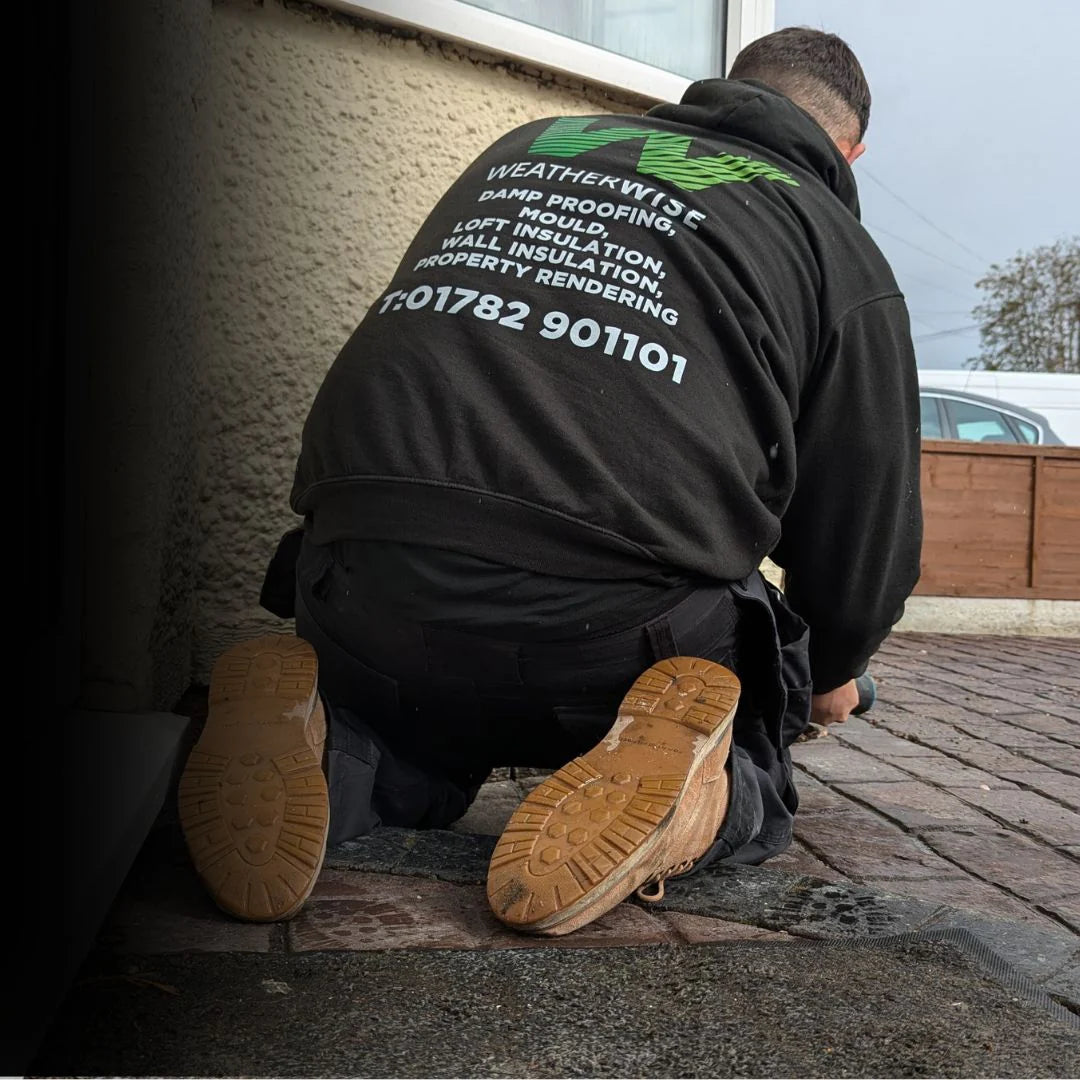

Bay windows are one of the most attractive features of many older homes.
But they're also an area where we regularly find damp-related problems.
You may notice:
Peeling paint beneath the window.
Crumbling plaster around the skirting.
Dark patches in the corners of the bay.
White salt deposits.
Black mould around the reveals.
A damp patch that becomes worse after rain.
The temptation is to look at damp near floor level and immediately call it rising damp.
But around a bay window, there can be several completely different explanations.
External ground levels, bridged damp-proof courses, rainwater penetration, defective pointing, sill details, cavity bridging, internal condensation and historic salt contamination can all create symptoms in roughly the same area.
For homeowners in Shrewsbury, particularly those living in older Victorian and Edwardian-style properties, the important question isn't simply:
"Is the wall damp?"
It's:
"Why is moisture appearing specifically around the bay window?"
🏠 Why Are Bay Windows Vulnerable To Damp?
A bay window projects beyond the main external wall of the property.
That means it has its own collection of junctions and details that need to manage weather effectively.
Depending on the construction, these can include:
- Window frames
- Sills
- Brickwork
- Mortar joints
- Render
- DPCs
- Cavities
- Roof details
- External ground levels
- Internal floor junctions
It also has more external surface area than a flat section of wall.
So when damp develops around a bay, we need to consider the whole construction, not just the internal plaster.
💧 Does Damp At The Bottom Of A Bay Window Mean Rising Damp?
Not automatically.
Rising damp is one possible mechanism for low-level moisture in masonry, but the position of a damp patch alone isn't enough to diagnose it.
Similar symptoms can potentially result from:
- High external ground levels
- Bridged DPCs
- Defective pointing
- Rain penetration
- Cracked masonry
- Defective sills
- Cavity bridging
- Plumbing leaks
- Salt contamination
- Condensation
This is why we prefer:
Inspect → Measure → Understand → Diagnose → Specify
rather than:
Low-level damp → assume rising damp → inject a new DPC.
🌳 Check The External Ground Level
One of the first details worth looking at around a damp bay window is the external ground level.
Older properties have often been altered considerably since they were built.
Over the years, homeowners may have installed:
- New driveways
- Patios
- Paths
- Paving
- Raised flower beds
- Decking
Each alteration can gradually increase the external level around the building.
If the external surface becomes too high relative to the damp-proof course, it may create a moisture pathway around the intended protection.
This is known as bridging.
🧱 What Is DPC Bridging?
A damp-proof course is intended to help prevent ground moisture moving upwards through the wall.
But it needs to remain appropriately positioned relative to the surrounding construction.
If external ground, render, plaster or another material creates a pathway around the DPC, moisture may bypass it.
Importantly, the DPC itself may not have failed.
It may simply have been bridged.
This distinction matters because installing another DPC doesn't necessarily remove the bridge.
🌧️ Does The Damp Get Worse After Rain?
This is a very useful question.
If damp around the bay becomes noticeably darker or larger following prolonged or wind-driven rain, we'd want to investigate the external elevation carefully.
Potential problems include:
- Weathered pointing
- Cracked mortar
- Damaged brickwork
- Failed render
- Window sealant defects
- Sill defects
- Roof details
- Rainwater goods
Rain correlation doesn't prove penetrating damp by itself, but it gives us an important diagnostic clue.
🪟 The Window Sill Is More Important Than It Looks
A window sill isn't purely decorative.
It's designed to help shed rainwater away from the wall beneath the window.
If the sill is:
- Cracked
- Damaged
- Poorly detailed
- Insufficiently projecting
- Incorrectly sealed
- Allowing water back towards the wall
rainwater can repeatedly wet the masonry beneath it.
Over time, this can contribute to internal damp symptoms.
💦 What Is A Drip Detail?
Many external sills incorporate a groove or detail underneath designed to interrupt the path of water.
Without an effective drip, rainwater can track back underneath the sill through surface tension rather than falling clear of the wall.
If this repeatedly wets the masonry below the window, the resulting internal damp may appear close to floor level.
That can easily be mistaken for moisture coming upwards from the ground when the water is actually arriving from above.
🧱 Could The Pointing Be Causing The Problem?
Yes.
Mortar joints form part of the weather-resisting surface of a masonry wall.
As pointing deteriorates, open or weathered joints can increase rainwater absorption.
Around bay windows, exposure can sometimes be greater because the structure projects from the main elevation.
We may therefore inspect:
- Open joints
- Missing mortar
- Cracking
- Inappropriate previous repairs
- Deteriorated pointing
The correct repair depends on the age and construction of the property.
Older buildings may also contain softer masonry and traditional mortar systems that need compatible repairs.
🧱 Could Water Be Crossing The Cavity?
Potentially.
In a cavity wall, the cavity helps separate the outer leaf from the internal construction.
But cavities can become locally bridged.
Potential causes include:
- Mortar droppings
- Construction debris
- Poor alterations
- Insulation issues
- Debris around openings
If moisture reaches a bridge, it may travel towards the inner leaf.
This can result in a localised damp patch that seems difficult to explain from inside the room.
🪟 Window Openings Have Complicated Junctions
Openings in external walls require careful moisture management.
Around windows we may need to consider:
- Sills
- Frames
- Sealants
- Pointing
- Lintels
- Cavity trays
- Weep holes
- Render junctions
A defect above or beside the window can sometimes produce moisture below it.
Water doesn't necessarily appear internally at exactly the same point where it entered externally.
💦 Water Can Travel Through Building Materials
This is an important part of damp diagnosis.
Water can move through:
- Brick
- Mortar
- Plaster
- Cavities
- Screeds
- Construction joints
Gravity influences it, but the pathway isn't always a simple vertical line.
So finding a damp patch beneath a bay window doesn't necessarily mean the moisture entered the wall directly behind that patch.
The job of the surveyor is to investigate the possible pathway.
🧂 What About Salt Contamination?
If masonry or plaster has experienced moisture movement over a long period, soluble salts may be transported into the internal finish.
When moisture evaporates, salts can remain behind.
This can complicate diagnosis because the plaster may continue behaving differently even after the original moisture source has changed.
Some salts are hygroscopic, meaning they can attract moisture from humid air.
So a wall can sometimes continue appearing damp even after a historic defect has been repaired.
⚪ Why Is There White Powder On The Wall?
White crystalline deposits are often described as efflorescence.
They can occur when moisture containing dissolved salts moves towards a surface and evaporates, leaving the salts behind.
Efflorescence tells us something about the wall's moisture history.
But it doesn't automatically identify the source.
We still need to ask:
Where did the moisture come from?
🌡️ Could Damp Around The Bay Actually Be Condensation?
Yes.
Bay windows can contain several relatively cold surfaces.
These can include:
- Window reveals
- External corners
- Areas beneath windows
- Wall/floor junctions
- Lintels
During colder weather, these surfaces may fall below the temperature of surrounding walls.
If internal humidity is elevated, the relative humidity immediately at those colder surfaces can become significantly higher than in the middle of the room.
That can create condensation and mould risk.
🍄 Why Is There Black Mould Around The Bay?
Black mould around window reveals and external corners often points us towards the relationship between:
Moisture + Surface Temperature + Ventilation
rather than automatically towards groundwater.
Bay windows can experience increased heat loss because they have more exposed external surface area.
If the surfaces become cold and indoor humidity is elevated, mould can develop.
This is particularly common:
- Behind curtains
- Behind furniture
- In the corners of the bay
- Around window reveals
- Along colder wall junctions
🪟 Why Do Curtains Make It Worse?
Heavy curtains can create another microclimate.
When they're closed, warm room air may not circulate effectively across the window and surrounding walls.
The area behind the curtains can become colder.
Moisture-laden air becomes trapped.
Surface relative humidity increases.
This can help explain why the rest of the room appears dry while mould develops around the bay.
🛋️ Furniture Can Have The Same Effect
A sofa positioned tightly within a bay can restrict air movement across the lower wall.
Again, the wall may become colder than the exposed surfaces around it.
This doesn't necessarily mean furniture is the sole cause.
But it can contribute to the environmental conditions allowing mould or surface condensation to develop.
🏠 What About Suspended Timber Floors?
Many older properties with bay windows also have suspended timber ground floors.
That introduces another area to investigate.
We may need to consider:
- Subfloor ventilation
- Air bricks
- External ground levels
- Joist ends
- Standing water
- Plumbing leaks
- Debris beneath the floor
- Timber moisture
If external paving has been raised around the bay, it may not only affect the DPC.
It can also partially bury or obstruct subfloor ventilation.
🌬️ Why Are Air Bricks Important?
Suspended timber floors rely on appropriate ventilation beneath the floor.
External air bricks allow airflow through the subfloor void.
Over the lifetime of an older property, these can become:
- Blocked
- Painted over
- Buried by paving
- Covered by extensions
- Obstructed internally
Reduced ventilation can contribute to elevated moisture beneath the floor.
That potentially affects both the masonry and structural timber.
🪵 Damp Around A Bay Can Also Affect Joist Ends
Where floor joists bear into external masonry, the embedded ends can experience different moisture conditions from the visible centre of the joist.
If the surrounding wall is persistently damp, we'd also want to consider the timber condition.
The visible floor may appear perfectly normal while hidden bearing points are exposed to elevated moisture.
This is why some low-level damp investigations naturally extend into timber assessment.
📟 Can A Moisture Meter Tell You What's Causing It?
Not on its own.
Moisture meters are useful investigative tools, but a high reading beneath a bay window doesn't tell us:
"This is rising damp."
It tells us we have an elevated reading that needs interpreting.
On masonry and plaster, readings can also be influenced by the material and salt contamination.
What matters is combining readings with the wider evidence.
🔍 Moisture Distribution Can Tell Us More
Instead of taking one reading, we may compare:
- Different heights
- Different sections of the bay
- Either side of the window
- Adjacent walls
- External corners
- Internal partitions
We then ask:
Does moisture reduce with height?
Is it concentrated beneath the sill?
Is only one side affected?
Does it correspond with external ground?
Does it worsen after rainfall?
Is black mould present instead of plaster deterioration?
These patterns can help narrow down the likely mechanism.
🏚️ Previous Repairs Can Complicate Diagnosis
Older Shrewsbury homes may have undergone many alterations.
For example:
A bay may have been replastered.
The windows may have been replaced.
A driveway may have been raised.
Old air bricks may have been buried.
Cement render may have been added externally.
A previous DPC may have been installed.
The property may have changed from open fires to central heating.
Each alteration can change how the building manages moisture.
That's why understanding the history of the building can be extremely useful.
❌ Why Simply Injecting A New DPC May Not Work
Imagine the actual cause is a defective sill.
Rainwater repeatedly enters beneath the window.
A contractor sees damp near the floor and installs a chemical DPC.
What happens?
The sill still leaks.
The wall still gets wet.
The customer has paid for a treatment that didn't address the moisture source.
The same applies if the real problem is:
- High external ground
- Cavity bridging
- A plumbing leak
- Condensation
- Defective pointing
The treatment must match the mechanism.
🎨 Why Repainting Often Fails
Decorating over a damp bay window may temporarily hide the symptom.
But if moisture continues entering the wall—or the surface continues experiencing high humidity—the decoration can fail again.
You may see:
- Bubbling paint
- Flaking
- Staining
- Crumbling plaster
- Mould returning
The wall isn't necessarily suffering from a decorating problem.
The decoration is simply showing us the consequences of a moisture problem.
🔍 How We Investigate Damp Around Bay Windows
At Weather Wise Solutions Limited, depending on the property and circumstances, we may assess:
- Moisture distribution
- Internal plaster
- Salt contamination
- DPC position
- External ground levels
- Floor levels
- Window sills
- Drip details
- Window frames
- Sealants
- Pointing
- Brickwork
- Render
- Cavities
- Rainwater goods
- Plumbing
- Suspended floors
- Air bricks
- Timber moisture
- Relative humidity
- Air temperature
- Surface temperature
- Ventilation
- Thermal bridging
We're not simply trying to establish that the wall is damp.
We're trying to determine:
Why is this bay window experiencing moisture?
🎓 Why Damp Diagnosis Requires More Than One Skill
A bay-window investigation can potentially involve:
Damp
Timber
Condensation
Ventilation
Building construction
Salt contamination
External defects
Our surveying team includes professionals holding industry-recognised qualifications including the Level 3 Award in Damp, Mould and Condensation in Buildings (L3 Award DMCB), the Certified Surveyor of Timber & Dampness in Buildings (CSTDB) and the City & Guilds-recognised Federation of Damp Certified Surveyor (FODCS) qualification.
Not every member of our surveying team necessarily holds every qualification, but collectively we continue investing in specialist knowledge across building moisture, timber and internal environmental conditions.
🛠️ How Do You Fix Damp Around A Bay Window?
There isn't one standard bay-window damp treatment.
High external ground levels
The external detail may need correcting to prevent bridging.
Defective pointing
Appropriate masonry repairs or repointing may be required.
Sill defects
The sill or surrounding junctions may need repairing.
Cavity bridging
The source of the bridge may need investigation and appropriate remedial work.
Penetrating rainwater
The external defect should be repaired before internal reinstatement.
Salt-contaminated plaster
The internal finish may require an appropriate remedial specification.
Condensation
Ventilation, heating, humidity, insulation and surface temperature may need consideration.
Genuine rising damp
Where investigation supports that diagnosis, an appropriate damp-proofing specification can be considered.
Timber problems
Where elevated moisture has affected structural timber, the moisture source and damaged timber both need addressing.
That's why we don't believe in one standard treatment for every damp bay.
🏡 Why Is Your Bay Window Damp?
The answer could be underneath it.
Beside it.
Above it.
Outside it.
Inside the cavity.
Or within the internal environment.
That's what makes bay-window damp such a good example of why diagnosis should come before treatment.
A damp patch tells us where the building is displaying a symptom.
It doesn't automatically tell us where the moisture originated.
Inspect → Measure → Understand → Diagnose → Specify.
📞 Damp Around A Bay Window In Shrewsbury?
If you've noticed damp, crumbling plaster, salts, condensation or black mould around your bay window, Weather Wise Solutions Limited can investigate the potential cause before recommending remedial work.
We're a family-run damp, timber, mould and ventilation specialist providing:
- Damp investigations
- Rising damp investigations
- Penetrating damp investigations
- Mould and condensation surveys
- Moisture profiling
- Timber surveys
- Suspended floor investigations
- Damp proofing
- Remedial plastering
- Ventilation solutions
We're proud members of the Damp Proofing Association and the Federation of Damp.
Our surveying team includes professionals holding industry-recognised qualifications including CSTDB, the Level 3 Award in Damp, Mould and Condensation in Buildings (L3 Award DMCB), and the City & Guilds-recognised FODCS qualification.
Don't treat the position of the damp. Diagnose the pathway that put it there.