













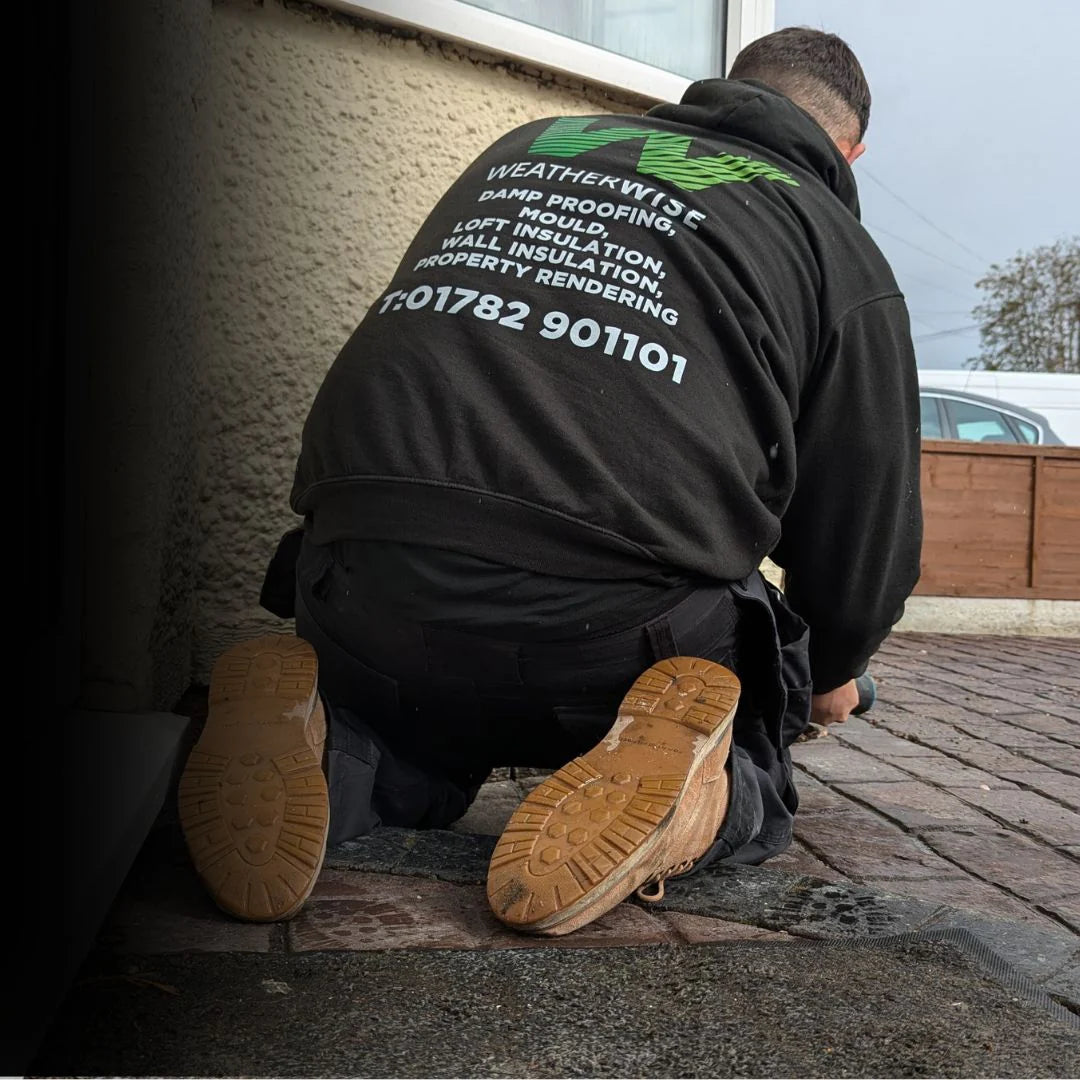

After heavy rain, have you ever noticed that one side of your house seems to stay wet long after the other walls have dried?
Perhaps the front elevation dries quickly, while a side wall remains visibly darker for hours—or even much longer during colder weather.
It can look concerning, particularly if you've also started noticing damp patches internally.
But different elevations of the same property can experience completely different moisture conditions.
The reason may involve:
Orientation.
Sunlight.
Prevailing wind.
Shelter.
Masonry porosity.
Pointing condition.
Temperature.
Evaporation.
For homeowners in Nottingham, understanding why one wall stays wet can help distinguish normal differences in weather exposure from a masonry defect or potential penetrating damp problem.
The important question isn't simply:
"Why is the wall wet?"
It's:
"Why is this wall behaving differently from every other elevation?"
🧭 Every Side Of Your House Experiences Different Conditions
We often think of a house as one building experiencing one set of weather conditions.
In reality, each elevation has its own environment.
One wall might receive direct sunlight for several hours.
Another could remain shaded for most of the day.
One elevation may face the prevailing weather.
Another could be sheltered by:
- Neighbouring properties
- Trees
- Extensions
- Garages
- Walls
- Other buildings
So two walls constructed from exactly the same brick and mortar can experience very different rates of wetting and drying.
🌧️ What Is Wind-Driven Rain?
Rain doesn't always fall vertically.
When strong wind accompanies rainfall, water can be driven horizontally against external walls.
This is particularly relevant to exposed elevations.
A wall facing the prevailing weather may receive considerably more direct rain than a sheltered elevation on the opposite side of the property.
The result can be obvious after a storm.
One wall appears saturated.
The opposite wall may barely look wet.
That doesn't necessarily mean the wetter wall is defective.
But increased exposure means its ability to absorb, manage and release moisture becomes more important.
☀️ Why Does Sunlight Make Such A Difference?
Once the rain stops, drying begins.
And solar exposure can have a significant influence on how quickly that happens.
A wall receiving direct sunlight warms more quickly.
As its surface temperature increases, evaporation can accelerate.
A shaded elevation may remain cooler for considerably longer.
This means one wall might look dry by lunchtime while another remains visibly dark into the afternoon.
The difference isn't necessarily how much rain entered the wall.
It may also be how quickly each wall can dry afterwards.
🧭 Why Does Orientation Matter?
The orientation of a property affects both:
- Weather exposure
- Solar exposure
A particular elevation may receive more wind-driven rain while also receiving less direct sunlight.
That's a challenging combination.
It gets wetter during rainfall.
Then it dries more slowly afterwards.
Over repeated wet weather, that elevation may remain at an elevated moisture content for longer periods than other parts of the house.
🧱 Brickwork Isn't Completely Waterproof
Traditional brick and mortar are porous materials.
They can absorb a certain amount of moisture during rainfall and subsequently release it as conditions improve.
That's part of normal masonry behaviour.
The problem develops when the amount of water reaching or entering the wall becomes excessive—or when the wall struggles to dry effectively between periods of rainfall.
This can be influenced by:
- Brick porosity
- Mortar porosity
- Cracking
- Weathering
- Exposure
- Previous repairs
- Surface contamination
- Existing moisture
- Temperature
That's why two neighbouring houses can respond differently to the same storm.
🧱 Why Can Old Brickwork Absorb More Water?
Masonry changes over time.
Decades of exposure can affect brick faces and mortar joints.
You may see:
- Weathered mortar
- Spalled brick faces
- Open joints
- Cracks
- Previous repairs
- Localised deterioration
These defects can change how rainwater interacts with the elevation.
Older brickwork isn't automatically defective, but its condition needs assessing rather than judging purely by age.
🧱 Mortar Joints Matter Too
People often concentrate on the bricks and overlook the mortar.
But pointing forms a substantial part of the external wall surface.
If joints become:
- Recessed
- Cracked
- Loose
- Missing
- Badly weathered
the wall may become more vulnerable to rainwater penetration.
Repairing defective pointing can therefore be an important part of managing an exposed elevation.
⚠️ Inappropriate Repairs Can Change Moisture Behaviour
Older buildings may contain softer masonry and traditional mortar systems.
Over the years, repairs may have been carried out using materials with very different characteristics.
Dense or incompatible repairs can potentially change how moisture moves through the wall and, in some circumstances, contribute to deterioration of surrounding softer masonry.
This is why repointing shouldn't simply mean:
"Use the hardest mortar possible so water can't get through."
The repair needs to be appropriate for the existing construction.
🏠 Why Does One Section Of The Wall Stay Wet Even Longer?
This is where the pattern becomes particularly useful.
Suppose most of an elevation dries normally but one rectangular section remains dark.
We'd want to ask what's different there.
Possibilities include:
- Different bricks
- Previous repointing
- An old opening
- Historic repair
- Cavity debris
- A leaking downpipe
- Overflowing guttering
- Cracked render
- A plumbing penetration
- Greater shelter from sun or wind
The shape and position of the wet area can provide clues about what's happening.
🌧️ Could Gutters Be Making The Wall Wetter?
Absolutely.
During heavy rainfall, defective rainwater goods can introduce far more water to a wall than normal weather exposure.
We may find:
- Overflowing gutters
- Leaking joints
- Blocked outlets
- Cracked downpipes
- Loose connections
- Water discharging against masonry
A wall below a leaking gutter may remain wet much longer because it isn't simply receiving rain.
It's receiving concentrated water from the roof.
💦 A Leaking Downpipe Can Be Surprisingly Difficult To Spot
Not every downpipe defect produces an obvious jet of water.
Some joints only leak during heavy rainfall.
Water may run down the back of the pipe where it isn't easily visible.
The surrounding brickwork becomes progressively saturated.
Then, after the rain stops, that section remains dark long after the rest of the wall has dried.
This is why inspecting a property during rainfall can sometimes provide extremely useful information.
🪟 What About Windows And Sills?
Window openings create several important junctions within an external wall.
Potential areas to investigate include:
- Frames
- Sealants
- Pointing
- Sills
- Drip details
- Lintels
- Cavity trays
- Weep holes
If rainwater isn't being effectively directed away from the opening, masonry beneath or beside the window may experience increased wetting.
The resulting internal damp patch may not appear directly beside the original defect.
💧 Water Doesn't Always Travel In A Straight Line
This is one of the most important concepts in penetrating damp diagnosis.
If water enters through an external defect, it doesn't necessarily travel horizontally through the wall and appear directly opposite.
Moisture can move through:
- Masonry
- Mortar
- Cavities
- Construction joints
- Plaster
- Screeds
Gravity influences the pathway, but so do absorbency and construction details.
So the internal symptom can sometimes appear some distance from the original external defect.
🧱 How Do Cavities Affect Moisture?
A cavity wall is designed so the outer leaf can manage exposure while the cavity helps separate that moisture from the internal construction.
But cavities aren't always clear.
Potential bridging can occur through:
- Mortar droppings
- Construction debris
- Insulation
- Alterations
- Poorly detailed openings
If rainwater enters the outer leaf and reaches a bridge, moisture may cross towards the internal wall.
That can create a localised internal damp patch even though there is no obvious defect immediately outside it.
🌧️ Why Can Damp Appear Hours After The Rain Stops?
Because moisture movement isn't always immediate.
During prolonged rainfall, masonry may gradually absorb water.
The outer wall becomes progressively wetter.
Moisture then travels through the material or through a defect.
Only later does the internal surface begin showing visible signs.
This can create a delay between:
Rainfall → Saturation → Moisture movement → Internal symptom
So homeowners sometimes report:
"It didn't actually appear while it was raining. The damp patch showed up the following morning."
That timing can still be relevant to rainwater penetration.
🧱 Could A Wet External Wall Make The Inside Colder?
Potentially.
Moisture conditions within building materials can affect thermal behaviour, while prolonged wetting can also coincide with colder external weather.
Internally, a colder surface can increase the risk of elevated surface relative humidity.
This means an externally exposed wall may potentially experience both:
Rainwater-related moisture
and
internal condensation risk.
Buildings don't always give us one convenient moisture mechanism at a time.
🌡️ Could The Internal Damp Actually Be Condensation?
Yes.
This is why rainfall correlation needs interpreting carefully.
Heavy rain often arrives alongside:
- Lower temperatures
- Higher outdoor humidity
- Reduced solar gain
- Closed windows
- Reduced ventilation
- Colder external walls
Those conditions can also increase internal condensation risk.
So:
"It gets worse when it rains"
is useful evidence.
But it doesn't automatically prove rainwater is penetrating through the wall.
🍄 What If There's Black Mould On The Inside?
Black mould can provide another clue.
If the affected area is concentrated around:
- External corners
- Window reveals
- Behind furniture
- Ceiling junctions
- Other cold surfaces
we'd want to consider internal humidity and surface temperature.
Penetrating damp and condensation can also occur together.
An exposed wall may become colder while indoor humidity remains elevated.
That creates a more complex moisture environment than simply labelling the problem "penetrating damp."
📟 Can A Moisture Meter Find The Leak?
Not by itself.
A moisture meter can help us identify patterns of elevated readings.
But it doesn't point towards a wall and say:
"Water entered through that mortar joint."
Instead, readings need to be interpreted alongside:
- Moisture distribution
- External defects
- Rainfall history
- Construction
- Wall orientation
- Surface temperature
- Relative humidity
- Salt contamination
The meter is part of the investigation—not the diagnosis itself.
🔍 Why Moisture Mapping Can Be Useful
Imagine we take readings across an internal wall.
Instead of simply recording one high number, we build a moisture profile.
Perhaps readings are highest:
- Beneath a window
- Beside a downpipe
- Around one corner
- At a wall junction
- Across a particular vertical band
We can then compare that pattern with the external elevation.
This helps us investigate possible pathways, rather than randomly repairing whatever defect happens to be easiest to see.
🧂 What About Salts?
Where masonry has experienced repeated moisture movement, soluble salts may be transported through the wall and deposited as water evaporates.
Some salts can subsequently influence internal finishes.
Hygroscopic salts can attract moisture from humid air, which means a previously damp wall can sometimes continue displaying damp-looking symptoms even after the original source has changed.
This is why we sometimes need to distinguish between:
Active water ingress
and
the legacy of historic moisture movement.
🧱 Why Doesn't Waterproof Paint Solve The Problem?
Painting over an internal damp patch doesn't stop water entering externally.
Likewise, simply coating the exterior without repairing defects isn't necessarily the right solution.
If the wall has:
- Cracked pointing
- A leaking gutter
- Failed sealant
- Damaged masonry
- A cavity bridge
those defects should be addressed.
Our preferred sequence is:
Diagnose → Repair → Prepare → Protect
Protection should complement good building maintenance—not replace it.
🛡️ Can Breathable Masonry Protection Help?
On suitable porous masonry, once defects have been repaired, a breathable water-repellent treatment can potentially reduce the amount of rainwater absorbed by the elevation.
Weather Wise Solutions Limited works with ProPERLA masonry protection systems.
ProPERLA Masonry Crème is designed to create a super-hydrophobic surface while retaining high water-vapour permeability, helping suitable masonry resist liquid rainwater without simply creating a conventional impermeable surface film.
The key point, however, is:
Repair first. Protect second.
Learn more about ProPERLA masonry protection
☀️ Does A Wall Staying Wet Mean It Needs Treatment?
Not necessarily.
Some difference in drying rate between elevations can be completely understandable.
A shaded wall facing prevailing weather may naturally remain wet longer than a sunny, sheltered elevation.
What becomes more concerning is when we also find:
- Persistent saturation
- Deteriorating pointing
- Spalled masonry
- Internal damp
- Recurring decoration failure
- Salt contamination
- Mould
- Defective rainwater goods
That's when further investigation becomes worthwhile.
📸 A Simple Tip For Homeowners
If you're experiencing a rain-related damp problem, take photographs.
Photograph the external wall:
Before rain.
During heavy rain if safe to do so.
Immediately afterwards.
Several hours later.
Also photograph any internal damp patch at the same intervals.
This can provide useful information about:
- Which elevation gets wettest
- Where drying is slowest
- Whether gutters overflow
- Whether downpipes leak
- How quickly internal symptoms develop
Weather patterns are evidence too.
🔍 How We Investigate An External Wall That Stays Wet
At Weather Wise Solutions Limited, depending on the property and circumstances, we may consider:
- Wall orientation
- Exposure
- Solar gain
- Shelter
- Brick condition
- Mortar condition
- Pointing
- Cracking
- Render
- Previous repairs
- Gutters
- Downpipes
- Window details
- Sills
- Roof junctions
- External ground levels
- Cavities
- Moisture distribution
- Internal plaster
- Salt contamination
- Relative humidity
- Surface temperatures
- Ventilation
We're trying to understand both sides of the equation:
Why is the wall getting so wet?
and
Why isn't it drying as quickly as the others?
🎓 Why Understanding Building Moisture Matters
A wet external wall can involve several areas of building pathology.
Rain exposure.
Masonry.
Damp.
Salts.
Cavities.
Internal condensation.
Timber.
Ventilation.
Our surveying team includes professionals holding industry-recognised qualifications including the Level 3 Award in Damp, Mould and Condensation in Buildings (L3 Award DMCB), the Certified Surveyor of Timber & Dampness in Buildings (CSTDB) and the City & Guilds-recognised Federation of Damp Certified Surveyor (FODCS) qualification.
Not every member of our surveying team necessarily holds every qualification, but collectively we continue investing in specialist knowledge across damp, timber, mould, condensation and building moisture diagnosis.
🏡 So Why Does One External Wall Stay Wet Longer?
Because every elevation experiences a different environment.
One may receive:
More rain.
More wind.
Less sunlight.
Less heat.
Less evaporation.
It may also contain:
More porous masonry.
Weathered pointing.
Previous repairs.
A local building defect.
The important thing is separating a wall that naturally dries more slowly from one that remains wet because something is wrong.
And if damp is appearing internally, don't assume the visible patch identifies where the water entered.
The defect, moisture pathway and internal symptom can all be in different places.
That's why our approach remains:
Inspect → Measure → Understand → Diagnose → Specify.
📞 External Wall Staying Wet In Nottingham?
If one side of your Nottingham home stays wet long after the other elevations have dried—or you've started noticing damp internally—Weather Wise Solutions Limited can investigate why.
We're a family-run damp, timber, mould and building-moisture specialist providing:
- Penetrating damp investigations
- Damp surveys
- External wall assessments
- Repointing
- Brickwork and render repairs
- ProPERLA masonry protection
- Mould and condensation assessments
- Timber surveys
- Damp proofing
- Remedial plastering
We're proud members of the Damp Proofing Association and the Federation of Damp, and we're a ProPERLA partner.
A wet wall tells us what we can see. A proper investigation tells us why it's happening.