













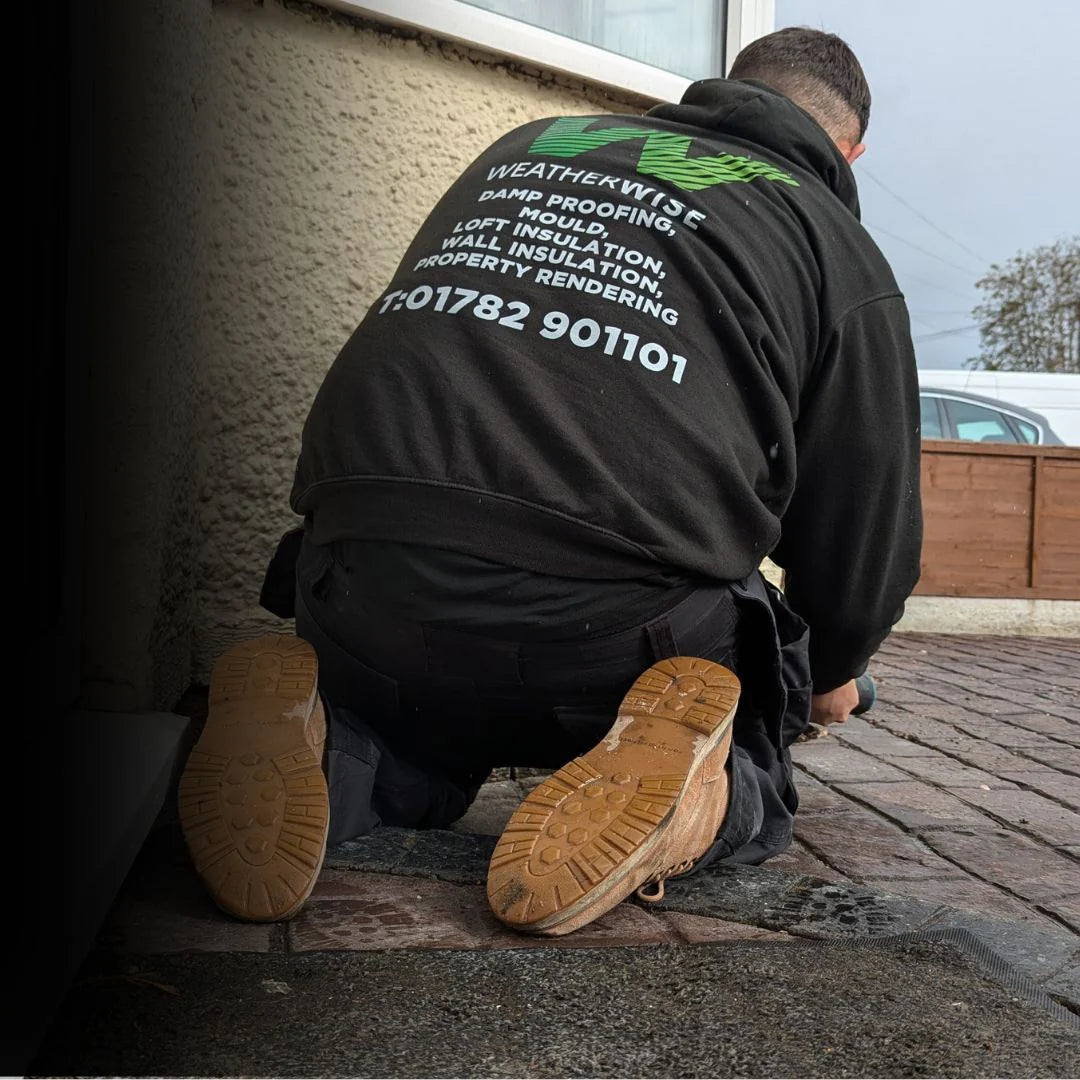

The bottom of a timber door frame rots first because that is where water collects and where the wood is least able to dry. End grain soaks water up like a straw, the threshold and the ground outside throw rain at it, and paint seals the moisture in. A frame with limited decay can often be repaired by cutting out the soft section and splicing in new timber. A frame that is soft right through needs replacing. In both cases the water has to be stopped first.
If you live in Tamworth and you have noticed a soft, flaking patch at the foot of a door frame, or a threshold that gives under a screwdriver, the first thought is usually that the whole door has to come out. Often it doesn't. Door frames are one of the most common places for wet rot to start in an otherwise sound house, and the damage is often smaller than it looks. What matters is understanding why that one spot went wet, because a repair that ignores the cause won't last.
Tamworth has a mix of older terraces and Victorian houses near the centre, interwar homes, and a lot of housing built from the 1960s onwards. The door frames in all of them have the same weak point. We'll go through why the foot of the frame rots, how to check it safely, what a proper repair involves and when a new frame is the better choice.
🚪 Why Does The Bottom Of A Timber Door Frame Rot First?
A door frame is a vertical piece of timber sitting on or near a hard, wet surface. Rain runs down the door, down the frame and onto the threshold. That is a lot of water arriving in one small area, and it has several ways of getting into the wood.
End grain drinks water
Timber is made of long fibres, a bit like a bundle of drinking straws. Water moves along those fibres far faster than it moves across them. The cut end of the frame, at the very bottom, exposes the open ends of the straws. If that end is sitting on a damp threshold or a wet step, it draws water straight up into the frame, sometimes by a hand's width or more.
Splashback from the ground
When rain hits a path, a step or a patio, it bounces back as fine spray. That spray lands on the lowest 30 to 40 centimetres of the door and frame again and again, in every shower. A raised path or a step that has crept up over the years makes it worse, because the frame is now closer to the splash zone than it was meant to be.
The threshold and cill hold water
Many thresholds and cills are shaped to shed water, but they don't all do it well. A worn weatherbar, a missing drip groove or a cill that has settled so it slopes towards the frame will leave a film of water standing at the joint. Timber that is wet for a few hours after every shower is timber that never properly dries.
Paint that lets water in but not out
Paint and varnish that are fresh and sound keep rain off timber. Paint that has cracked, flaked or worn at the corners does something worse. Water finds its way in through the crack, and the intact paint around it then slows the wood from drying. The wood stays damp behind a surface that looks mostly fine.
Wood that is already tired
Older frames were often made from timber that was more durable than much of what is sold now, but they have had decades of wetting and drying. Newer frames in softwood, particularly ones painted on site without proper sealing of the cut ends, can fail sooner than you would expect. Neither is a reason to panic. It just explains why you see the problem on houses of every age.
🔍 How Can You Tell If A Door Frame Is Rotten?
You don't need special equipment for a first check. A few minutes on a dry day with a small screwdriver will tell you a good deal.
What to look for
- Paint that is bubbling, peeling or flaking at the foot of the frame.
- Wood that looks dark, grey or stained near the bottom.
- A soft or spongy feel when you press with a thumb.
- Cracks running along the grain, or small cubes or crumbs of wood.
- A threshold that has sunk, split or lifted.
- A door that sticks, drops or no longer closes squarely.
The probe test
Take a small screwdriver or a bradawl and press it gently into the wood at the bottom of the frame, a little way up from the floor, and on the threshold. Sound timber resists, and the tip barely marks it. Rotten timber lets the point sink in, and the wood may break away in a crumbly lump or come out in soft strings.
Work up the frame in small steps. The point where the wood goes from soft to firm tells you how far the decay has gone. Mark it with a pencil. Do the same on the other side, because a frame is often worse on the side that takes the weather.
Press gently. You are checking the wood, not trying to make a hole in it. And if the door is a fire door or the frame holds up something structural, leave the probing to a professional.
What the results usually mean
| What you find | What it often means |
|---|---|
| Soft for a few centimetres at the very foot only | Early decay from end grain wetting. Often repairable. |
| Soft up one side to knee height or more | Longer-term wetting. A larger splice, or a new section of frame. |
| Soft on both sides and across the threshold | The whole base is affected. A new frame is more likely. |
| Firm wood but flaking paint | Surface failure. Strip, dry, treat and repaint. |
| White strands or a musty mushroom smell | Possible dry rot. Get it looked at before you do anything else. |
| Soft wood and a damp wall beside it | The wall may be feeding the timber. Look at the wall too. |
🪵 Is It Wet Rot Or Dry Rot?
Nearly all rot found at the foot of an external door frame is wet rot. It needs timber that stays wet, and the bottom of a frame is exactly that. Wet rot tends to stay in the area that is wet. The wood goes dark, soft and cracks across the grain, and it often smells damp and earthy.
Dry rot is rarer here, but it is the one to take seriously. It can spread through masonry and into timber that is not itself wet, and it tends to show as a grey-white growth, rusty red spore dust or a cracked, cuboid pattern in the wood. It likes still, poorly ventilated spaces, so it is more likely if the frame is built into a wall that stays damp, or if the damp has been there a long time and the area behind the frame is closed in.
You can't always tell the two apart by eye, and the treatment is different. If you see anything that looks like fungal growth rather than just soft wood, don't pull things apart. Get a specialist to look at it. Our post on how to tell wood rot from woodworm explains the main signs, and our wet rot treatment page sets out how we deal with it.
🧱 Is The Wall Beside The Frame Part Of The Problem?
Often it is, and it is the part most people miss. A door frame is built into a wall, and if that wall stays wet, the timber beside it stays wet too. You can replace the frame and the new wood will start taking up water from the wall.
Things to look at on the wall
- Ground level. Is the path, step or soil higher than the damp proof course, which is usually a visible line or a row of bricks a couple of courses above the ground? If it is, moisture can travel from the ground into the wall.
- Render or plaster running down below the damp proof course and bridging it.
- Cracked pointing or render beside the frame, where rain can soak in.
- A downpipe or gutter above the door that overflows or leaks onto the frame.
- Damp inside. Staining, peeling paint or a cold, clammy patch on the inside wall near the door.
Reading the signs
If the timber is wet only on the outside of the frame and the wall is dry, the problem is probably local: splashback, a poor threshold or paint failure. If there is damp on the wall as well, higher than splashback would reach, the wall needs looking at. You can read more about the common causes on our pages on rising damp and penetrating damp, and in our post on why damp can be worse on one side of a doorway.
Why this matters for the repair
A repair is only as good as the dryness of the wood it is joined to. If new timber is spliced onto a frame that is sitting in a wet wall, the new piece will go the same way. That is why we always look at the cause before the cure.
🛠️ Can A Rotten Door Frame Be Repaired Instead Of Replaced?
Yes, when the decay is limited and the timber around it is sound. This is the same principle as repairing a rotten window sill, which we covered in our post on whether a rotten window sill can be repaired instead of replaced. The difference with a door frame is that it is partly structural, because the door is hung from it, so the repair has to be done carefully.
What a splice repair involves
- Find and fix the reason the wood got wet.
- Probe the frame and mark where sound wood begins.
- Cut out the rotten section back to firm timber, usually with a clean, square or angled cut.
- Let any remaining timber dry. Moisture readings help show when it is ready.
- Treat the exposed ends of the old timber with a suitable preservative, following the maker's instructions.
- Fit a new section of timber, jointed and fixed so it supports the frame and the door.
- Seal the cut ends and the whole repair, prime and paint, paying special attention to the underside and the end grain.
What makes a splice repair work
- The decay is confined to the lower part of the frame.
- The timber above the cut is firm and dry.
- The frame is still fixed securely to the wall.
- The cause of the wetting has been put right.
- The new timber is a suitable species and treated or sealed on all faces, including the ends.
Who does the work
A carpenter or joiner does the cutting and fitting. We aren't joiners, and we won't pretend to be. What we do is find out why the timber went wet, check how far the decay has reached and whether the wall and neighbouring timbers are affected, and treat the timber where treatment is needed. That gives the joiner a sound base to work to.
⚖️ When Is A New Frame Better Than A Repair?
Some frames can't sensibly be repaired. A new frame is worth considering when:
- The rot runs a long way up both sides, so most of the frame would be new timber anyway.
- The threshold or cill is rotten as well, and the junction between them has failed.
- The frame has split, twisted or pulled away from the wall.
- Dry rot has been found, which needs a wider investigation than a patch repair.
- The door no longer hangs properly and the frame is out of square.
- The frame has been repaired several times already and keeps failing in the same place.
Replacing a frame is a bigger job. The old frame has to be taken out without damaging the brickwork, the opening checked for damp and decay, and a new frame fitted and sealed to the wall. That's the best time to put right whatever caused the problem, such as a missing damp proof course detail, a raised path or a poor threshold. You should be given the reasoning for either choice, and not simply a quote.
A repair that lasts versus one that doesn't
The most common reason a frame repair fails is that the original cause wasn't fixed. A new section of timber on a wet threshold, with bare end grain and fresh paint over damp wood, will start to rot again, often within a few winters. A repair done on dry timber, with the ends sealed and the water managed, can last a long time.
🌧️ What Is Making The Frame Wet In The First Place?
Before anything is cut out, it helps to work out which of these is at play. Often it is more than one.
Rain and splashback
If the door faces the prevailing weather, the frame takes more rain. Check for a canopy or porch, a drip on the door, and whether water is running off the roof or gutter onto the doorway.
Threshold and cill design
Look at the joint between the frame and the threshold. Is there a gap, a failed sealant bead or a worn weatherbar? Does the threshold slope away from the door or towards it? A little water in the wrong place goes a long way.
Ground levels
A path or patio laid close to the door, or one that has been resurfaced and ended up higher than before, will push water at the frame and the wall. Where possible, the finished surface should sit below the damp proof course with a fall away from the house.
Gutters and downpipes
A leaking joint in a gutter or a blocked downpipe near the door will send water down the frame or the wall beside it. This is one of the quickest things to check and one of the easiest to put right, so it is worth doing early. It is also part of why this time of year, with leaves in the gutters and heavy showers, tends to show up door problems.
Condensation inside
Inside, the bottom of a door and frame is often the coldest part of a hallway. Warm, damp air from the house settles there and turns to water, which can run onto a timber threshold. It is rarely the sole cause of rot but it adds to the problem, particularly on a door that is already prone to damp. We looked at this in our post on condensation on the inside of a front door.
Plumbing and outside taps
A dripping outside tap, an overflow pipe or a leaking waste pipe close to a door can keep a frame wet all year. If the damp is worse in one spot, look at what is near it.
🎨 Will Paint, Sealant Or Preservative Stop A Frame Rotting?
They help, but they don't replace dryness. It is worth knowing what each one can and can't do.
Paint and varnish
A good, intact coat keeps rain off and slows the wood taking up water. The weak spots are the corners, the joints and the bottom edge, which are where the film cracks first. Repainting doesn't fix wood that is already wet, because the wood needs to be dry first.
Wood preservative
A preservative treatment can help protect timber from fungal attack, and it is often used on a repair. It works best on dry, sound timber and it doesn't turn wet or soft wood into good wood. Follow the manufacturer's instructions and use the product for the job, and don't treat it as a reason to leave a wet frame as it is.
Sealant
A bead of sealant between the frame and the wall, or the frame and the threshold, helps keep water out of joints. It must be applied to clean, dry surfaces, and it will eventually fail, so it is part of the maintenance and not a once-and-done fix. Sealing the joint at the very bottom so water can't drain out can do harm by trapping water behind it, so leave weep paths clear where the detail calls for them.
End grain
Any cut end of timber should be primed and painted before it is fitted, including the bottom of the frame. It is a few minutes of work and one of the most useful things you can do for a frame's life.
🧭 What Can Tamworth Homeowners Check This Week?
- On a dry day, press a screwdriver gently into the base of each external door frame and the threshold. Note anything soft.
- Look at the paint at the corners and the bottom edge. Flaking and bubbling are early warnings.
- Look at the gap between the frame and the threshold. Is the sealant intact?
- Check the ground level beside the door. Is it above the damp proof course, or sloping towards the house?
- Look up. Is a gutter or downpipe dripping onto the doorway?
- Check inside. Is there staining, peeling paint or a damp patch on the wall beside the frame?
- Note whether the door still hangs and closes squarely.
If you find one soft patch and the rest is sound, you probably have time to plan. If the decay runs a long way up, or you see signs of fungal growth, or the wall is wet too, it is sensible to have someone look sooner rather than later. The longer timber stays wet, the more it costs in time and effort to put right.
🔬 How Do We Look At A Rotten Door Frame In Tamworth Homes?
When we are asked to look at a rotten frame, we don't start with the timber. We start with the water.
We look at the door, the threshold, the frame and the wall around them, and at the ground, gutters and drainage outside. We take moisture readings in the timber and in the masonry, probe the wood to see how far the decay goes, and check whether it is wet rot, dry rot or something else such as woodworm. We look at the inside face of the wall as well, to see whether the damp is travelling through.
Timber decay is the subject of the Certified Surveyor of Timber and Dampness in Buildings (CSTDB) qualification, one of the qualifications held by professionals in our surveying team. Our surveyors page explains who we are. The aim is to tell you what is wrong, why, and what is the sensible fix, and to be plain about what is a job for a joiner, a roofer or a plumber and what is a job for us.
Related reading
If you have found decay in another part of the house, these may help. We wrote about timber in a different spot in the right way to treat wet rot in skirting boards in Tamworth homes, and about hidden timber problems in can floor joists look fine but still be decaying.
📋 What Is The Quick Answer?
- The foot of a door frame rots first because end grain, splashback, a worn threshold and tired paint all push water in at the same spot.
- Probe the wood gently with a screwdriver to find where sound timber starts.
- Limited decay in a frame that is otherwise sound can often be cut out and spliced. A frame that is soft on both sides and across the threshold usually needs replacing.
- Fix the cause of the wetting first, including the wall, the ground level, the gutters and the threshold.
- Seal and prime every cut end, and keep paint and sealant in good order.
- If you see white strands, a mushroom smell or a cuboid pattern in the wood, get it looked at before it is disturbed.
📞 Rotten Door Frame In Tamworth?
If you have a soft frame, a sinking threshold or damp beside a door, we can come and find out why. Our surveys are free, and we cover the area around Tamworth, including our Tamworth page.
We're members of the Damp Proofing Association, the Federation of Damp and Trust a Trader, and we're CHAS accredited and Google Guaranteed. Our surveying team includes professionals holding the Certified Surveyor of Timber and Dampness in Buildings (CSTDB) qualification alongside the Level 3 Award in Damp, Mould and Condensation in Buildings (L3 Award DMCB) and the City and Guilds-recognised Federation of Damp Certified Surveyor (FODCS) qualification. WeatherWise's staff have over 40 years' combined experience.
Book your free survey with Weather Wise Solutions on 01782 901101, or send us a message.