













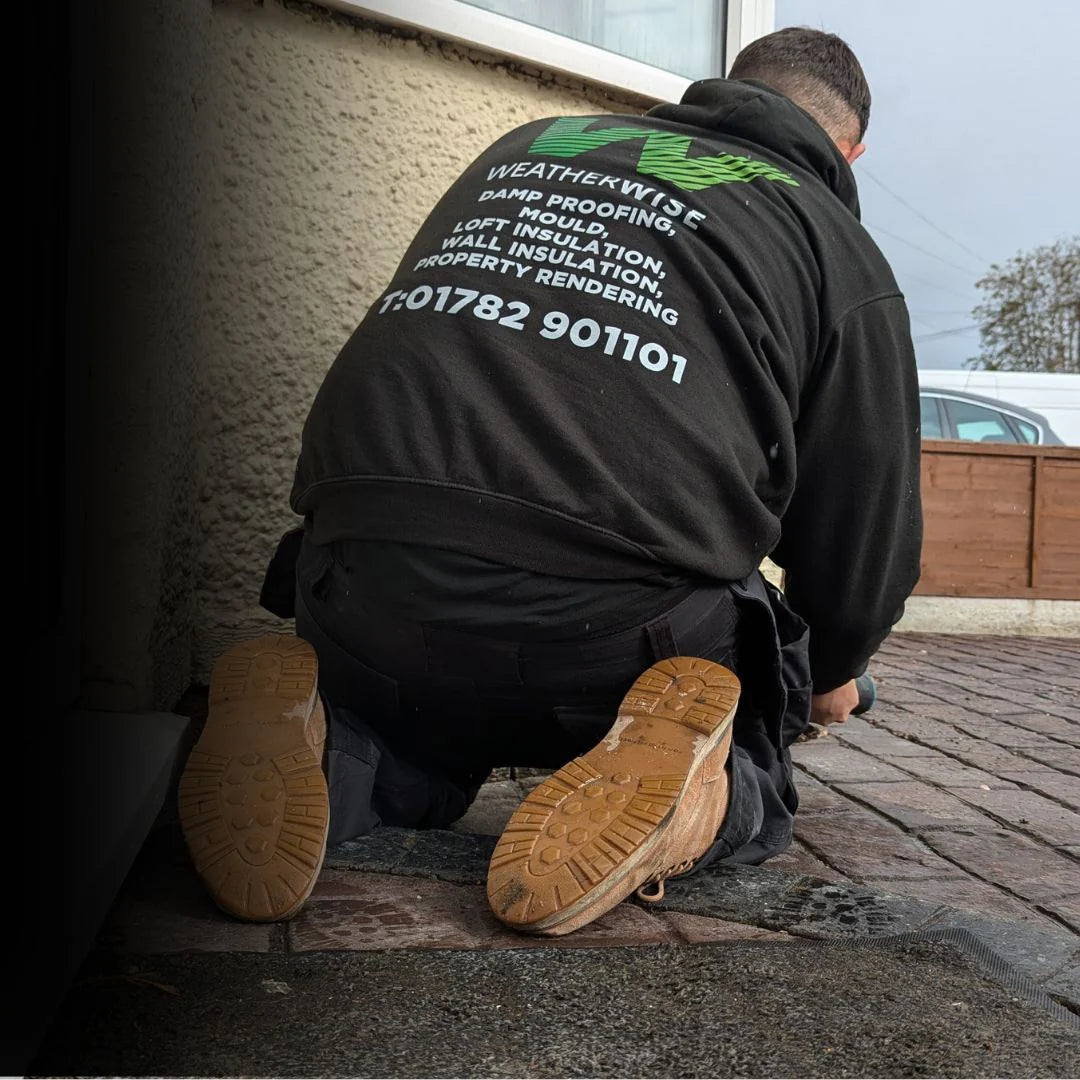

A good damp survey starts outside the house, not with a meter pushed into the wall. The outside of a building gives away a surprising amount: a gutter that has been leaking for years, a path that has crept up the brickwork, a downpipe that stops short of the drain. Walk in and start taking readings first, and it is easy to name the wrong type of damp and pay to fix a problem you never had.
In this week's episode of The Healthy House Podcast, Aaron Worrall talks to Kevin Topping, who works in waterproofing, about education, training and how a proper diagnosis is made. A lot of the conversation comes back to one idea: look before you measure. This guide takes that idea and turns it into something you can use at home, whether you are trying to understand a surveyor's report or deciding what to check before you call anyone.
We'll cover why a meter reading on its own can mislead, what a surveyor should be looking at outside, the questions worth being asked inside, how temperature and humidity fit in, and how to tell rising damp, penetrating damp and condensation apart.
🔎 Why Should A Damp Survey Start Outside The House And Not With A Damp Meter?
Because damp is a water problem, and water has to come from somewhere. A meter tells you that a wall has something going on. It does not tell you where the water came from, how it is getting in, or whether it is still arriving. Those answers are usually outside, or in the way the house is lived in.
Think of a doctor who orders a test before asking where it hurts. The test may be useful, but it means far more once you know the story. A damp survey works the same way. The building has a history, the weather hits it from one side more than the other, and the people living in it heat it, ventilate it and use it in their own way. All of that is evidence.
Starting outside also protects you from the most common mistake in the trade, which is deciding what the damp is before you have looked at the cause. A patch of dark, cold plaster low on a wall can be rising damp, penetrating damp, condensation, a leak or a mix of two. They look alike from a distance. The fixes are completely different, and so are the bills.
🧭 What Does "Root Cause" Actually Mean?
It means the reason the moisture is there, not just the stain you can see. A wet patch is a symptom. The cause might be a cracked gutter, soil piled against the wall, a failed seal round a window, a leaking pipe, a cold wall in a room that is never ventilated, or a combination. Treating the symptom, by painting over it, plastering it or putting a treatment in the wall, without finding the cause is how a patch comes back a year later.
🎙️ What Did Kevin Say On The Healthy House Podcast?
Kevin Topping works in waterproofing, and in the episode he talks about how he learned the trade, why training matters and how he approaches a survey. These are his words from the episode, taken from a machine transcript of the audio, and they are his views, not ours. Aaron Worrall hosts the show and Weather Wise Solutions presents it.
On where a proper diagnosis begins, Kevin says at [29:31]:
"100%, a correct diagnosis starts with a good survey."
On what a surveyor should do before going inside, at [30:14]:
"What they should be doing is, and specifically how I've been taught, is you look outside because the outside of that property is gonna give you a lot of answers."
On the tools a surveyor already has with them, at [31:21]:
"The best thing a surveyor has are the things he was born with, which is his eyes, his ears, his nose and his touch."
And on gathering evidence before naming the problem, at [33:08]:
"You've got to get that information together before you can confidently say to that homeowner this is what it is."
You can hear all of it, and much more about training, products and the industry, on the full episode, and find out more about the guest on Kevin's guest page.
Kevin also described the kind of clues he looks for outside, and we'll come back to those below. Everything else in this guide is Weather Wise Solutions' own advice, kept separate from his.
🧪 Why Can A Damp Meter Reading Mislead You?
Most handheld damp meters work by passing a tiny electrical signal into the surface and measuring how easily it travels. Water conducts electricity, so a wetter surface gives a higher number. That sounds simple, but a few things get in the way.
⚡ Salts, Metal And Surface Moisture All Change The Number
Salts that have built up in old plaster draw moisture from the air and also conduct electricity, so a wall can read high without being very wet. Foil-backed plasterboard, nails and metal pipes behind the surface can do the same. A film of condensation on the surface can make a reading jump, because the meter is reading the water on the paint, not what is inside the wall.
📈 A High Number Does Not Name The Cause
This is the point Kevin comes back to. A high reading tells you there is moisture. It does not tell you whether it is coming up from the ground, in from outside, out of the air or from a pipe. Kevin explained that when condensation is the problem, a meter can still read very high, which is why people end up told they have rising damp when the real cause is something else.
🔢 A Few Readings In One Spot Is Not A Survey
Another common shortcut is to take two or three readings near the skirting board and stop. Moisture moves, and a wall can be very different at knee height, shoulder height and at the corner. A useful survey maps the wall, checks the room and compares it with the outside, rather than leaning on one number.
Our own guide to using a damp meter and reading the results properly goes into this in more detail, and the podcast episode Damp Meters and the Unregulated Damp Industry Explained looks at what meters can and cannot tell you.
🌧️ What Should A Surveyor Look At Outside First?
The outside of a house is the first half of the survey. Here is what is worth checking, and why each one matters.
🚰 Gutters, Downpipes And Hoppers
A gutter that overflows, a joint that drips or a downpipe that empties against the wall puts water on the brickwork every time it rains. Over months, that water soaks into the wall and shows up as a damp patch inside, often at a height that has nothing to do with the ground. Look for green staining down the wall, a wet patch under a joint, and a downpipe that finishes short of the drain.
🌿 Moss, Lichen And Plants
Moss and lichen grow where brickwork stays wet. Kevin mentioned looking for moss and lichen on the brickwork and for plants growing out of the guttering, and both are good clues that a lot of water is landing in one place. Ivy and other climbers can also hold moisture against a wall and push into mortar joints.
🧱 Brickwork, Mortar And Render
Crumbling mortar, cracked render, spalling bricks and gaps around windows and doors let rain in. Penetrating damp tends to show up after wet weather and on the side of the house that takes the worst of it. Our page on penetrating damp explains the usual routes in.
🪜 Ground Levels, Paths And The Damp Proof Course
The damp proof course is a barrier near the base of the wall that stops moisture rising from the ground. If soil, a patio, a path or a flower bed has been built up above it, water can cross the barrier and get into the wall above. Kevin mentioned checking that the damp proof course has not been bridged. It is easy to do without realising, for example when a flower bed or patio is built up against the house.
🕳️ Signs Of Cavity Wall Insulation Or Wall Ties
Kevin said he looks for drill marks that show cavity insulation has been blown into the wall, and for signs that wall ties have been added recently. Both can change how a wall behaves. Insulation that has bridged the cavity, or a wall tie that has been fitted badly, can give moisture a path inside, so they are worth knowing about before anyone decides what is wrong.
🌬️ Air Bricks, Vents And Openings
Blocked air bricks, covered vents and gaps where pipes and cables pass through the wall change how air and water move. They are quick to check and often missed.
🏠 What Questions Should Be Asked Inside?
The next half of a survey is a conversation. The house cannot tell a surveyor how it behaves over a day, a week or a season, but the people who live in it can.
🕰️ When Did You First Notice It?
A problem that started last winter points somewhere different from one that has been there for ten years. A patch that appeared just after a storm, a building project, a new boiler or new windows tells you something too.
🌅 Does It Come And Go?
Kevin gave an example of a householder saying the problem is there first thing in the morning and gone a couple of hours later, and explained that this suggests something to do with the room warming up. That fits condensation, which forms when warm, damp air meets a cold surface and eases as the room warms. A patch that stays put whatever the weather and the time of day points elsewhere.
🌧️ Is It Worse After Rain?
If the damp spreads after heavy rain and fades in a dry spell, water is probably getting in through the wall, the roof or a window. If it never changes, think about a leak or a source in the ground.
🔥 How Is The Room Used?
A bedroom where the window stays shut at night, a kitchen without a working extractor, a spare room that is never heated and a bathroom with a weak fan all have a different story to tell. How you cook, wash, dry clothes and heat the house is part of the evidence.
🌡️ Where Do Temperature And Humidity Fit In?
Once the outside has been checked and the questions asked, the numbers become much more useful.
💨 Inside And Outside Conditions
Kevin described checking the air temperature and relative humidity inside, and also outside, to compare the two. Relative humidity is a measure of how much water the air is holding compared with the most it could hold at that temperature. If the air indoors is very humid and the walls are cold, condensation is likely. Measuring outside as well gives context, because the weather on the day changes everything.
🥶 Cold Spots And Dew Point
The dew point is the temperature at which the air can no longer hold its water and starts to drop it as droplets. If a wall surface is at or near the dew point, condensation will form on it. Kevin talked about using a thermal imaging camera, inside and outside, to find cold spots that a meter can miss. A cold spot is a place where heat escapes faster, such as a corner or a lintel, so the surface is cooler and attracts moisture.
📸 A Snapshot Or A Pattern?
Any single set of readings is a snapshot. Moisture in a home changes by the hour and by the season, so a snapshot can mislead. Readings logged over days or weeks show the pattern. We look at how that works in our post on data loggers and better ventilation.
🧩 How Do You Tell Rising Damp, Penetrating Damp And Condensation Apart?
Here is a quick guide to what each type tends to look like and where to look first. It is a guide, not a diagnosis, and real homes often have more than one thing going on.
| What you see | What it might be | What to check outside first |
|---|---|---|
| A tide mark low on a ground-floor wall, often with white salts, in dry weather as well as wet | Rising damp | Ground levels, paths and beds against the wall, and whether the damp proof course is bridged |
| A patch that appears or spreads after heavy rain, often on the most exposed wall | Penetrating damp | Gutters, downpipes, mortar, render, window seals and roof edges |
| Black spots in corners, wet windows and a musty smell, worse in the morning and in the coldest rooms | Condensation | Ventilation, heating pattern and cold walls, rather than anything outside |
| A patch that stays the same in all weather, or a wet spot near a pipe | A leak | Where the pipes run, the outside tap, overflow pipes and the drain |
🌱 Rising Damp
Rising damp is moisture travelling up through a wall from the ground, usually a few feet at most, and often with a tide mark and salts. It is real, but it is less common than many people are told. Our page on rising damp explains what it looks like and how it is dealt with, and our guide to the types of damp in homes compares them side by side.
🌧️ Penetrating Damp
Penetrating damp is water coming through a wall, roof or opening from outside. It follows the weather, and the cause is usually a defect you can see if you look for it. It can appear at any height.
💨 Condensation
Condensation is not water coming into the building. It is water vapour already inside, landing on cold surfaces. It is the most common cause of mould in homes. Our pages on condensation and damp and mould cover what to do about it.
🔀 When It Is More Than One
Plenty of houses have two causes at once, for example a leaking gutter wetting the wall and poor ventilation keeping the room humid. If a surveyor names only one, ask whether the others have been ruled out.
🧰 What Can You Check Yourself Before You Call Anyone?
You can gather a lot of the evidence yourself, and it makes any visit more useful. None of this replaces a survey, and none of it needs a ladder.
🚶 Walk Round The Outside In The Rain
A wet day shows you what a dry day hides. Look at where water runs, where it drips and where it pools. Check that downpipes empty into a drain and that gutters are not overflowing.
📏 Look At The Base Of The Walls
Check how high the ground, path or patio sits against the brickwork. If you can see the damp proof course line, soil and slabs should sit below it.
📝 Keep A Simple Diary
Note when the problem appears, what the weather was doing, whether the heating was on and what you were doing in the room. Even two weeks of notes can point to a pattern.
📷 Take Photos
Photos of the patch taken once a week, in the same light, show whether it is spreading or fading. Keep any photos of the outside as well.
🚫 Hold Off On Painting Over It
It is tempting to cover a stain, but fresh paint hides the evidence and can trap moisture. If you can, leave it as it is until it has been looked at.
🎓 Why Does Training Matter For A Damp Survey?
Kevin's wider message in the episode is about education, and it applies to anyone who tells you what is wrong with your house. Damp is a subject where a confident answer is easy and a correct one takes knowledge. Asking about a surveyor's training and how they reached their conclusion is reasonable.
Our surveying team includes professionals holding the Level 3 Award in Damp, Mould and Condensation in Buildings (L3 Award DMCB), the Certified Surveyor of Timber & Dampness in Buildings (CSTDB) qualification and the City & Guilds-recognised Federation of Damp Certified Surveyor (FODCS) qualification. You can read more about the people and what they do on our qualified surveyors page.
Our post on damp proofing qualifications and rising damp explains what the different qualifications cover.
🔍 How Do We Investigate?
A visit starts with a conversation. We ask how you live in the house, how you heat it and ventilate it, and when you see the problem.
Then we look. We check the windows, walls, ceilings and corners, take moisture readings, look at the ventilation and heating, and check the outside of the building for gutters, downpipes and pointing. The aim is to tell condensation from penetrating damp, a leak, rising damp or something else, so you only pay to fix what is wrong.
If the answer is habits and ventilation, we say so. If something needs doing to the building, we explain what and why. Weather Wise Solutions is family and friends run, and our staff have over 40 years' combined experience.
❓ Common Questions About Damp Surveys And Meter Readings
🧭 Can A Damp Meter Tell Me What Type Of Damp I Have?
No. It shows that a surface has moisture or conducts more than expected. Working out the type needs the outside, the history of the problem, the room conditions and often more than one tool.
🌱 Is A High Reading Always Rising Damp?
No. Condensation, salts in old plaster, a leak and rain coming through the wall can all give a high reading. Rising damp is one possibility among several, so a high number should start the investigation, not end it.
🌡️ Why Do Some Surveyors Use A Thermal Imaging Camera?
It shows surface temperature, so cold spots stand out. That helps spot cold bridging, missing insulation and areas where condensation is likely. It does not show moisture directly, so it is used alongside other checks.
📅 Does It Matter What Time Of Year A Survey Is Done?
It helps to see a problem when it is active. Condensation tends to show in the colder months and penetrating damp after rain. A good surveyor takes the season into account and asks what the problem does the rest of the year.
🏠 Should I Worry If I Have Been Told I Have Rising Damp?
Not straight away. Ask what evidence the diagnosis was based on, whether the outside was checked, and whether condensation, a leak and penetrating damp were ruled out. A second opinion is reasonable before spending money.
📞 When Should I Book A Survey?
If a patch is spreading, if mould keeps returning after cleaning, or if you have been given a diagnosis you are unsure about, a survey is worth having. A free survey is a sensible first step.
🎧 Listen To The Full Episode
If you want to hear Kevin Topping talk about training, products and how a proper diagnosis is made, listen to the full episode, Education is the Best Solution to a Healthier Home, on The Healthy House Podcast.
📞 Damp Or Mould At Home?
If you have a damp patch, mould you cannot explain or a diagnosis you are not sure about, we can help you find the cause before you spend anything on a fix.
We are members of the Damp Proofing Association, the Federation of Damp and Trust a Trader, and we are CHAS accredited and Google Guaranteed.
Book your free survey with Weather Wise Solutions on 01782 901101 or through our contact page, and meet the team on our qualified surveyors page.
📝 The Short Version
A damp meter shows that moisture is there. It does not say where it came from.
A good survey starts outside, with gutters, downpipes, ground levels, brickwork and the damp proof course.
The history matters: when it started, whether it comes and goes, and whether rain makes it worse.
Temperature and humidity, inside and outside, help tell condensation from other causes.
If you have been told it is rising damp, ask what the diagnosis was based on.