













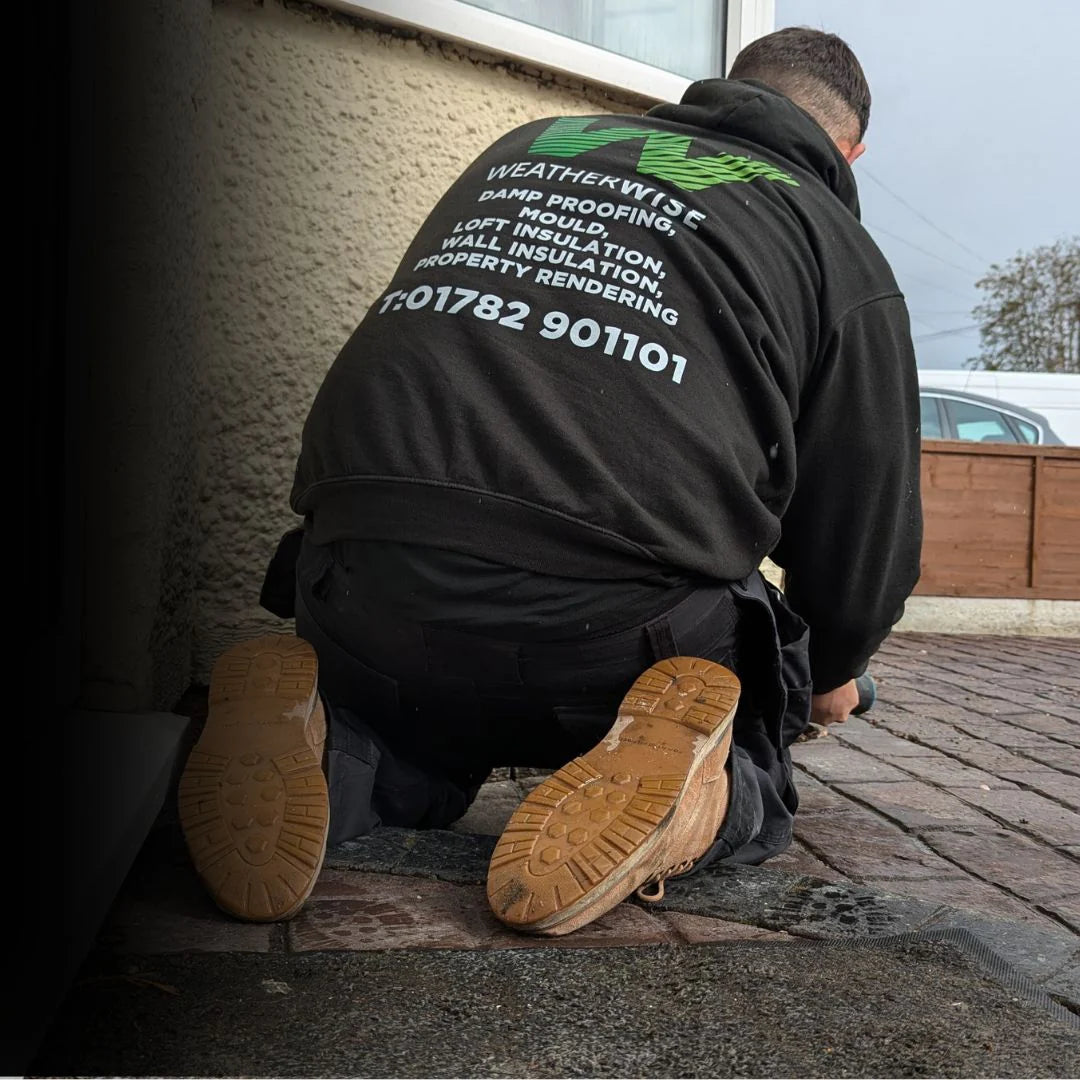

One wet wall doesn't automatically mean every wall needs protecting. Rule out the defects first, then protect the elevation that really takes the weather.
One wall of your house is damp. The other three look fine.
Maybe it's the gable end that faces the moors. Maybe it's the back wall where the paint keeps blistering, or the front elevation that never seems to dry after a wet week.
So the question comes up:
👉 "Should I have the whole house treated with masonry protection, or just the wall that gets wet?"
👉 "Is it worth protecting a wall that isn't causing a problem yet?"
👉 "Could something else be causing it, and would protection be wasted money?"
The short answer is that the wall that gets wet is telling you something, and it's worth listening before anything is sprayed or rolled on. A single wet elevation usually has a reason. Sometimes that reason is simply that it takes the brunt of the weather. Often it's a defect that needs fixing first, and protection only makes sense once the wall is sound.
This guide explains why one wall can get far wetter than the others, what to rule out before you think about protection, when breathable masonry protection is the right answer, and when it isn't. It's written with Buxton homes in mind, where weather and stone are part of the story, but it applies to any house.
🌧️ Why Does Only One Wall Get Wet?
Rain doesn't fall evenly on a house. In most of the UK the wind-driven rain, the rain that arrives sideways rather than straight down, comes mostly from one or two directions, usually from the south-west and west.
That means:
- One elevation takes far more rain than the others.
- Sheltered walls barely get wet at all.
- A wall that faces away from the sun stays wet longer, because it dries more slowly.
Exposure matters more than the amount of rain
Two houses in the same street can have very different walls. A gable end with nothing in front of it takes the full force of a storm. The same wall, shielded by a neighbouring building or a row of trees, hardly notices it.
Height and position matter too
The higher a wall sits above its surroundings, and the more open the ground around it, the more wind-driven rain it collects. Gable ends, tall walls, corner properties and houses on open or sloping ground are all more exposed.
What it tells you
If the wet wall is the exposed one, that's a good sign for the explanation, but it doesn't prove protection is the answer. We look at the pattern in more detail in Why Does One External Wall Stay Wet Longer Than The Rest Of The House?, and at the weather side of the story in Why Does My Wall Get Wet Only During Wind-Driven Rain?
Wind direction + exposure + slow drying → one wet elevation.
🧱 Is Brickwork Or Stone Naturally Porous?
Yes. Bricks, stone and mortar are all porous to some degree. They soak up water like a hard sponge, hold it, and release it again as the weather improves.
Why that's normal
A wall that gets wet in the rain isn't automatically defective. Solid walls are designed to absorb some moisture and then dry out. The cavity or the thickness of the wall is meant to cope with it.
When it becomes a problem
Trouble starts when the wall absorbs water faster than it can dry, or when something lets water in that was never meant to get through.
- very porous or weathered brick and stone
- crumbling or eroded mortar joints
- a wall that stays saturated for long periods
- an interior that shows the moisture: damp patches, peeling paint, staining or mould
Different materials behave differently
Soft, old brick, sandstone, gritstone and limestone, hard engineering brick and render all take up and release water at different rates. That's why two walls on the same house can behave differently, and why advice that suits one wall may not suit another.
Porous wall + prolonged wetting + slow drying → moisture reaching the inside.
🔎 What Should You Rule Out Before Thinking About Protection?
This is the most important part of the article.
Masonry protection works on a sound wall. It doesn't repair a wall that's letting water in through a fault. If the real problem is a defect, treating the wall surface simply covers the symptom.
Before you decide, it's worth looking at all of these.
1. Gutters and downpipes
A blocked, cracked or leaking gutter is one of the most common causes of one wall getting wet. Water overflows or drips down a single elevation, soaks the same strip of wall again and again, and leaves a stained, damp patch below the fault.
Autumn leaves make this much more likely at this time of year. If the wet patch sits directly below a gutter joint, a bend or a downpipe, start there.
2. Pointing and mortar joints
Mortar joints that have eroded, cracked or fallen out let rain straight into the wall. Often it's one elevation that's affected, because that's the one that took the weather for years.
Hairline gaps can be enough. If the joints are failing, they need repairing before anything else. We look at this in Should You Repoint A Wall Before Applying Masonry Protection? and Can You Apply Masonry Protection After Repointing?
3. Cracks in brickwork, stone or render
Cracks let water in directly. Render can also sound hollow where it has come away from the wall behind, trapping water. Water running through a crack can dampen a patch on the inside a long way from where it got in.
4. Windows, sills and lintels
A failed seal, a sill that sheds water towards the wall instead of away, a cracked reveal or a defective lintel above an opening will make one part of a wall wet. We often see damp patches around a window on the most exposed elevation only.
5. Ground levels and paths
If the ground outside has been raised, or a path or patio butts up against the wall, rain splashes up and soaks the base of the wall, and can bridge the damp proof course. Damp that comes from the ground looks different from damp that comes from above, which is another reason to look at the pattern.
6. Chimneys, flashings and roof edges
Water getting in around a chimney stack, a poorly fitted flashing or a damaged verge can run down a wall and show as a damp patch on one side of the house.
7. Plumbing and internal sources
A leak in a pipe, a radiator valve or a bath can create a damp patch that looks like weather damage. So can condensation on a cold external wall. If the patch doesn't change with the weather, the answer may not be outside at all.
Check gutters → Check joints → Check cracks → Check openings → Check ground → Check flashings → Check inside.
⚖️ So Should You Protect Just The Wet Wall, Or All Of Them?
Once the defects have been ruled out and fixed, the question is more straightforward.
If one elevation really is far more exposed
If a single wall takes much more wind-driven rain than the others, and it's porous or weathered, protecting that wall can make sense. The other walls aren't suffering, so there's no obvious reason to treat them just because one is.
If the whole house has similar porous masonry
Different walls on the same house can be the same material. If every elevation is porous brick that soaks up water, you might choose to protect more than one for consistency or appearance, but that's a choice, not a necessity. Walls that aren't taking in water don't need treating.
If the wet wall is wet because of a fault
Fix the fault, let the wall dry, and then reassess. In many cases, once the cause is dealt with, the wall stops being wet and protection isn't needed at all.
A word about appearance
Masonry protection is usually clear and designed not to change how the wall looks, but it's sensible to test an inconspicuous area first. Treating only one wall of a house can make sense on a gable, but if it's the front, you may want to think about how it will look next to untreated brickwork over time.
Rule out defects → fix them → let the wall dry → decide which elevations need protection.
🛡️ What Does Breathable Masonry Protection Actually Do?
Breathable masonry protection is a water-repellent treatment, applied to the outside of the wall. It's designed to soak into the surface of porous masonry and make it repel liquid water, while still letting water vapour pass out.
That second part matters. A wall needs to be able to dry.
What it's for
- reducing how much rain soaks into porous brick and stone
- helping a sound but absorbent wall stay drier in wet weather
- reducing the risk of penetrating damp reaching the inside
- helping the wall dry out more quickly between showers
Why breathable matters
A wall that can't breathe can trap moisture. That's why sealing a wall with a non-breathable paint or sealer can make problems worse, as the water that does get in can't get out again. We explain the difference in Why Is Breathable Masonry Protection Better Than Waterproof Paint? and What Is Masonry Crème And How Does It Protect External Walls?
What it isn't
Masonry protection isn't a repair. It doesn't fill cracks, replace missing mortar, fix a gutter or cure rising damp. It works on a wall that's in reasonable condition, and it's one part of an answer, not the whole of it.
ProPERLA
One option is ProPERLA, a breathable masonry protection product. Whichever product is used, the principle is the same: protect a sound wall, keep it able to breathe, and don't treat a wall that has an unresolved fault.
Sound wall + breathable protection → less water in, vapour still out.
🕰️ How Dry Does The Wall Need To Be First?
Another point that catches people out. Protection applied over a very wet wall can hold moisture inside it, and a wall that's been saturated for weeks needs time to dry before any treatment.
If the wall has just been repaired, repointed or cleaned, it needs to dry out first. We cover this in Does Brickwork Need To Be Completely Dry Before Applying Masonry Protection?
Autumn is not always ideal for this. Walls dry slowly in cool, damp weather, and a dry spell is what you're waiting for.
🏔️ Why Can Buxton Homes Be Different?
Every area has its own weather and building stock, and it's worth thinking about both.
Exposure and weather
Buxton sits high in the Peak District, on the edge of open moorland, and the town and its villages are known for weather that can be wet and exposed. Homes on open or elevated ground take a lot of wind-driven rain, and the elevation facing the prevailing wind can be much wetter than the rest of the house.
Stone and older buildings
Many older Buxton homes are built from local stone, and there are Victorian and Georgian terraces and houses around the town. Stone, mortar and old walls behave very differently from modern brick and cavity construction. Older walls are often solid, and they rely on being able to breathe. That's one reason a breathable approach matters, and why it's sensible to be careful with anything that might trap moisture.
Conservation areas and listed buildings
Parts of the area lie within conservation areas or the Peak District National Park, and some properties are listed. If your home is listed or in a conservation area, check what's permitted before changing the finish of an external wall.
Pointing and mortar
In older stonework, the type of mortar matters. Hard, cement-rich repairs on soft stone can make the stone decay faster. If pointing needs repair on an older building, it's worth making sure the mortar suits the wall.
If you're in Buxton or nearby, our Macclesfield page covers the area close to you, and you can book a visit through our contact page.
🗺️ How Can You Tell What's Causing The Wet Wall?
The pattern of the damp is a big clue. Here's a quick guide.
| What you see | Most likely cause | What to check |
|---|---|---|
| Wet patch directly below a gutter joint or downpipe | A leaking or overflowing gutter | Look at the gutter in heavy rain |
| Wet, dark wall on the exposed elevation only, after wind and rain | Wind-driven rain on porous masonry | Compare with a sheltered wall |
| Damp patch around one window | Sill, seal, reveal or lintel | Check the sill slopes away from the wall |
| Damp along the bottom of the wall | Ground levels, splashback, bridging | Look at paths, patios and the damp proof course |
| Patchy damp that gets worse after rain | Cracks, failed pointing or render | Look closely at joints and render |
| Damp that stays the same in dry weather | A leak or internal source | Check pipes and plumbing |
| Cold, damp corners with mould, worse in the morning | Condensation | Check humidity and ventilation |
Several causes can be present on the same wall, which is why it pays to look properly rather than guess.
⏳ What's A Simple Way To Watch The Wall?
You can learn a lot from a few weeks of notes.
Step 1: Look from outside in heavy rain
Safely, from the ground, look at gutters, downpipes and the wall. Where is water going?
Step 2: Photograph the wall wet and dry
Take pictures from the same spot, at the same time of day, after rain and after a dry spell. Does the wet area change?
Step 3: Compare walls
Check the other elevations in the same conditions. Is the wet wall really wetter, or does it just look worse?
Step 4: Check inside as well
Look at the inside of the same wall. Patches that grow after rain point to water coming from outside. Patches that don't change point somewhere else.
Step 5: Read the results
- Wet only in wind and rain, dries quickly afterwards → an exposed porous wall
- Wet below a gutter or window → a local defect
- Stays wet in dry weather → a leak or a different cause
- Worse on cold mornings → condensation
Look → Photograph → Compare → Check inside → Decide.
📏 Can You Trust A Moisture Meter Here?
A moisture meter can help compare one part of a wall with another, but it isn't a diagnosis. Most hand-held meters respond to salts, surface moisture and the material itself, not just water coming through the wall.
A reading is useful alongside the pattern, the construction, the condition of the outside and the weather history. It shouldn't decide whether a wall needs protection on its own.
🎙️ Hear More On The Healthy House Podcast
In the first episode of The Healthy House Podcast, Damp Explained: What Every Homeowner Should Know, Aaron Worrall talks to damp specialist Paul Hughes about the main types of damp, how to tell them apart and why so many homes are misdiagnosed. It's a useful listen if you're trying to work out whether a wet wall is penetrating damp, condensation or something else. Aaron hosts the show, and Weather Wise Solutions presents it.
🔍 How Do We Investigate A Wall That Gets Wet?
We work out why the wall is wet before suggesting any treatment. Depending on the property, that can include:
- looking at the pattern, height and position of the damp, inside and out
- checking gutters, downpipes, roof edges and flashings
- inspecting pointing, cracks, render and the condition of the masonry
- checking windows, sills and lintels on the same elevation
- looking at ground levels, paths and the damp proof course
- checking moisture readings against drier areas
- looking at humidity and ventilation inside
- asking about the property's history: previous repairs, repointing, coatings and alterations
Then we explain what we've found in plain English, including when the answer is that nothing needs treating, or that a repair has to come first.
Look → Check outside → Check inside → Measure → Find the source.
Our diagnosing damp page explains our approach in more detail, and our penetrating damp page covers damp that comes through from outside.
🛠️ How Is It Fixed?
The right fix depends entirely on the cause.
Gutters and downpipes
Clearing, realigning or replacing them, so water goes where it should.
Pointing and cracks
Repairing joints and cracks with a mortar that suits the wall, then allowing time to dry.
Windows, sills and lintels
Sealing, reshaping or replacing parts that let water in.
Ground levels and splashback
Lowering or adjusting ground and paths so they don't bridge the damp proof course.
Porous but sound masonry
Once the wall is sound and dry, breathable masonry protection on the elevation that needs it.
Condensation and internal causes
Better ventilation and steadier heating, which a coating on the outside can't solve.
Fix the cause first. Protect the sound wall afterwards.
🎓 Why Does The L3 Award DMCB Matter Here?
A wall that looks wet from outside can have several things going on at once: rain, condensation, a defect, salts or the building's construction. Telling them apart takes an understanding of how moisture moves through a building, not just a look at the surface. That's what the Level 3 Award in Damp, Mould and Condensation in Buildings (L3 Award DMCB) is about.
Our surveying team includes professionals holding the L3 Award DMCB, the Certified Surveyor of Timber & Dampness in Buildings (CSTDB) and the City & Guilds-recognised Federation of Damp Certified Surveyor (FODCS) qualification.
🤝 Who Will Carry Out Your Survey?
Weather Wise Solutions is a damp and mould specialist based in Newcastle-under-Lyme, working across Staffordshire, Cheshire, Greater Manchester, Merseyside, North Wales and Derbyshire.
We're members of the Damp Proofing Association and the Federation of Damp, we're on Trust a Trader, we hold CHAS accreditation and we're Google Guaranteed. You can meet our surveyors before your visit.
🏁 So Should You Apply Masonry Protection If Only One Wall Gets Wet?
Not automatically. First find out why that wall is wet.
One wall can take far more wind-driven rain than the others, simply because of its position.
Gutters, pointing, cracks, sills, ground levels and flashings are all common causes, and all need ruling out.
Masonry protection works on a sound wall. It doesn't repair a faulty one.
Breathable protection lets the wall dry. Non-breathable coatings can trap moisture.
If one elevation really is the exposed one, protecting just that wall can make sense. Walls that aren't taking in water don't need treating.
Look → Rule out → Fix → Dry → Then decide.
📞 Wet Wall Or Penetrating Damp In Your Buxton Home?
If one wall of your home keeps getting wet, Weather Wise Solutions can find out why before you spend money on protection. We deal with:
- damp surveys and damp diagnosis
- penetrating damp investigation and repair
- breathable masonry protection
- condensation and mould control
- ventilation, including PIV and extractor fans
- timber decay, woodworm and wet rot
- rising damp and damp proofing
Members of the Damp Proofing Association and the Federation of Damp. CHAS accredited and Google Guaranteed. Our surveying team includes professionals holding the Level 3 Award DMCB, the CSTDB and the City & Guilds-recognised FODCS qualification.
Book your free survey with Weather Wise Solutions on 01782 901101 or through our contact page.