













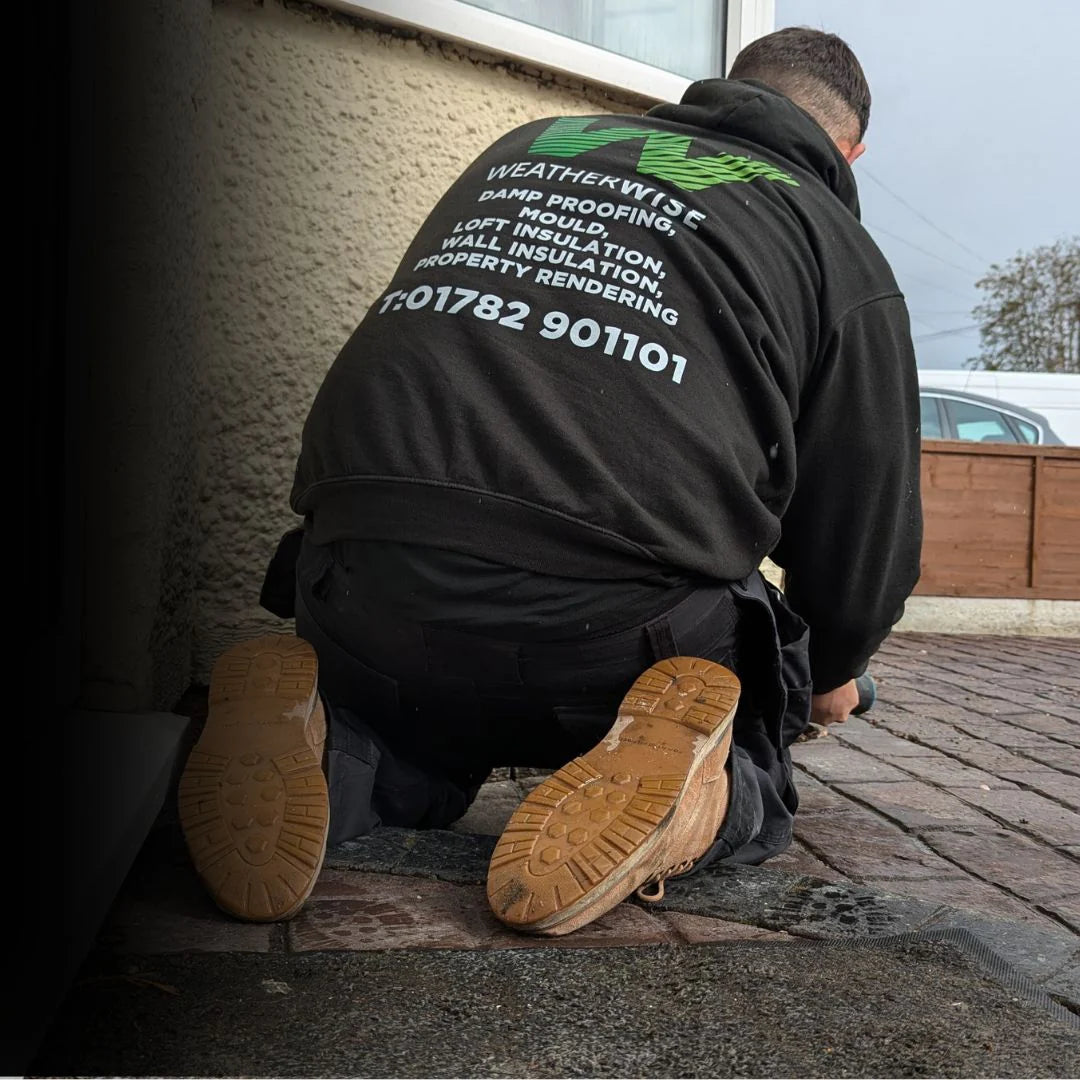

A new patio or driveway can change how moisture reaches the base of your walls. A new damp problem afterwards doesn't automatically mean the damp proof course has failed.
The patio looks fantastic. The driveway is finally finished. The garden has been transformed.
Then, a few weeks later, a patch of damp appears low down on an inside wall, or the skirting board starts to bubble, or the room by the back door begins to smell musty.
So the questions start:
👉 "Has the new patio caused this?"
👉 "Has the damp proof course failed?"
👉 "Do I need the whole wall treated, or is something simpler going on?"
The honest answer is that new paving can cause damp, but not in the way most people assume. It rarely "breaks" anything. Instead, it changes the relationship between the ground outside and the base of the wall, and that can let moisture reach places it never reached before.
This guide explains how that happens, what to check first, what's usually the cause, and how it's fixed. It's written with Chorley homes in mind, but it applies to any house with a new patio, path or driveway.
🧱 What Is A Damp Proof Course, And Where Should It Sit?
A damp proof course (DPC) is a barrier built into a wall, usually a few courses of brick above the outside ground level. In older homes it may be slate, bitumen or a similar layer. In newer homes it's usually a plastic membrane.
Its job is simple: stop moisture in the ground from travelling up through the masonry.
Why the height matters
A DPC only works if it stays above the ground and above anything that splashes or piles up against the wall. The usual rule of thumb is that the outside ground level should sit comfortably below the DPC, so rain and soil can't reach it.
What goes wrong with new paving
If the patio, path or driveway is laid up to or above the DPC, the wall can take up moisture from the ground above the barrier. The DPC is still intact. It's just been bypassed.
DPC intact + ground raised above it → moisture bypasses the barrier.
🌧️ How Can A New Patio Or Driveway Cause Damp?
There are several routes, and they often work together.
1. Raised ground levels
Paving is built up in layers: a sub-base, a bedding layer, then the slabs or blocks. Each layer adds height. On a house where the old ground sat comfortably below the DPC, a thick new patio can easily bring the surface up to it.
2. Bridging the damp proof course
When paving, soil, gravel or render touches the wall above the DPC level, water can pass straight across. Builders and homeowners call this bridging. We look at the wider picture of it in Is My Property Bridging The DPC? Common Causes And Fixes.
3. Poor drainage falls
Paving should slope gently away from the house so water runs off. If it's level, or slopes towards the wall, rainwater collects at the base of the wall and soaks in. A patio laid flat can hold a puddle against the brickwork every time it rains.
4. Splashback
Hard surfaces make rain bounce. Water hitting a patio next to a wall splashes up the lower brickwork, wetting it again and again. Over time that can keep the base of the wall damp, and carry dirt and salts up with it.
5. Buried or blocked air bricks
Many older homes have air bricks that ventilate the space under a timber floor. Paving laid over them, or soil and gravel piled against them, shuts that ventilation off. We explain why it matters in Is It Worth Replacing Old Air Bricks?
6. Changed drainage patterns
A big area of hard paving sheds a lot more water than a lawn does. That water has to go somewhere. If it's channelled towards the house, or it overwhelms a soakaway or gully, the ground by the wall can stay wetter than before. We look at drainage more broadly in Can Poor Drainage Around A House Cause Damp?
Higher ground + flat or wrong falls + splashback + blocked ventilation → a wetter wall base.
🔎 Why Doesn't A New Damp Problem Mean The DPC Has Failed?
This is the most important point in the article.
When damp appears low on a wall, many people hear "rising damp" and assume the DPC has stopped working. Sometimes that's right. But when the problem starts soon after building work outside, it's worth asking a different question first: what has changed?
The DPC may be perfectly fine
If the barrier is intact and the ground has been raised above it, the damp isn't rising through the DPC. It's getting around it. Injecting a new chemical DPC wouldn't solve that, because the moisture would simply find another way in, above the new barrier.
Treating the symptom doesn't help
Replastering and redecorating the inside wall, without dealing with the cause outside, usually means the same stain comes back.
The fix may be much simpler
Lowering the ground, clearing the bridge, correcting the slope or reopening an air brick can be a far more sensible first step than any injected treatment. We make the same point about the wider "fix the cause first" approach in Should I Tank My Wall Or Fix The Ground Outside First?
New damp after outside work → check what changed before assuming the DPC failed.
📏 How High Should The Ground Be Next To My Walls?
There's no single magic number for every house, because the right level depends on the DPC position and the wall construction. But the principle is consistent.
- The outside ground should sit clearly below the DPC.
- There should be a visible gap between the top of the paving and the DPC line.
- Nothing, whether soil, gravel, render or concrete, should bridge across that gap.
How to find your DPC
On many older homes the DPC sits a few courses above the ground, and you can sometimes see a thin dark line in the mortar, or a row of slightly different bricks. On newer homes it may be a plastic strip in the bed joint. If you can't find it, a surveyor can show you where it is and where the ground should be.
If the patio was laid by a landscaper
Most landscapers lay paving to look good and drain well, and many do it carefully. But the position of the DPC isn't always on their radar, particularly on an older house where the line isn't obvious. If you're planning work, ask the person doing it to find and respect the DPC level before they start.
🕳️ What Happens To Air Bricks And Ventilation?
Houses with suspended timber floors rely on air moving through the void underneath. That air carries moisture away and keeps the timbers dry.
How paving blocks it
If a patio or path is built up against the wall, the air bricks can end up buried, partly covered or sitting below ground level. The air stops moving, the void gets damper and the timbers underneath can suffer.
What you might notice
- a musty smell from the floor
- floorboards that feel cold or damp
- skirting boards that are damp at the bottom
- in worse cases, signs of timber decay under the floor
What helps
Air bricks need to stay clear and above ground level. Where levels have been raised, vents may need to be lowered, extended or ducted through the new surface. We cover the condensation side of this in Do Air Bricks Help Prevent Condensation?
Blocked air brick + damp void → damp floors and a risk to timber.
🧂 Why Can Salt Staining Appear After New Paving?
Moisture from the ground carries dissolved salts. When it reaches the wall and evaporates, the salts are left behind.
What salts look like
- white, powdery or fluffy deposits on brickwork
- flaking paint or lifting plaster
- patches that look dry one week and damp the next, depending on the air
Why it can get worse after work
A wall that was previously dry can start drawing up moisture, and the salts that come with it, once the ground has been raised or the base is being splashed. Salts attract moisture from the air, which is why a wall can feel damp even on a dry day.
What it tells you
Salts show that moisture has been moving through the wall. They don't tell you why. That's the job of the survey.
🔍 What Should You Check First?
Before anyone talks about injection or tanking, it's sensible to walk around the outside of the house and look.
1. Compare the ground to the DPC
Look at the lowest courses of brick. Can you see the DPC? Is the paving, soil or gravel clearly below it, or is it level with it or covering it?
2. Look at the falls
After rain, or with a bucket of water poured on a dry day, watch where the water goes. Does it run away from the house, or sit by the wall?
3. Check the air bricks
Can you find them? Are they clear? Are they above ground level?
4. Look for contact with the wall
Is paving, a raised bed, a shed base or a pile of gravel touching the wall above the DPC?
5. Check gutters and downpipes
A leaking gutter or downpipe that discharges onto the patio can soak the same strip of wall every time it rains.
6. Check inside
Where is the damp on the inside? Is it low on the wall, close to the outside work? Does it follow the line of the patio?
Compare levels → Check falls → Find air bricks → Look for contact → Check gutters → Check inside.
🗺️ How Can You Read The Pattern?
| What you see | Most likely cause | What to check |
|---|---|---|
| Damp low on an inside wall, just behind the new patio | Raised ground or bridged DPC | Compare paving height to the DPC |
| Damp that gets worse after heavy rain | Poor falls or splashback | Watch where rainwater goes |
| Musty smell and damp skirting by the floor | Blocked air bricks or damp subfloor | Find and clear the vents |
| Damp patch below a gutter joint or downpipe | Leaking or overflowing rainwater goods | Look at the gutter in rain |
| White salt deposits on low brickwork | Moisture moving through the wall | Find where the moisture enters |
| Damp that stays the same in dry weather | A leak or a different cause | Check pipes and plumbing |
| Cold, damp corners with mould, worse in the morning | Condensation | Check humidity and ventilation |
Several causes can overlap, which is why it pays to look carefully rather than guess. If you want to see how a surveyor reads a damp pattern more generally, our post Why Can Damp Be Worse On An Internal Wall Than An External Wall? is a good companion.
🏠 Why Do Chorley Homes Need A Closer Look?
Every area has its own mix of homes, and it's worth thinking about yours.
A mix of ages and styles
Chorley and the villages around it have a range of housing, including older terraces and mill-era homes, inter-war and mid-century semis and more recent estates. Older homes are more likely to have solid walls, suspended timber floors, air bricks and an older DPC or none at all. Newer homes are more likely to have cavity walls and a plastic DPC in a known position.
Older homes and breathable walls
Older walls often rely on being able to breathe. Anything that traps moisture at the base, such as a cement-heavy render or paving piled against the wall, can make them wetter.
Plenty of outdoor work
Patios, driveways and re-landscaped front gardens are common projects for homeowners across Lancashire and Greater Manchester. That's good for kerb appeal, but it's why levels and drainage deserve a quick check before the work starts.
If you're near Chorley, our Wigan page and Bolton page cover the nearest areas we serve, and you can book a visit through our contact page.
🌱 What About Driveways, Paths And Raised Beds?
It's not only patios.
Driveways
A driveway that slopes towards the house sends water to the wall. Block paving and resin-bound surfaces shed water more quickly than gravel does, so where that water goes matters.
Paths
A path laid tight against the wall can bridge the DPC or hold water against the base.
Raised beds and planters
Soil piled against a wall stays wet, passes moisture into the masonry and can bridge the DPC. It's a common cause that's easy to overlook.
Sheds, bin stores and extensions
Concrete bases and lean-to structures built against a wall can change drainage and level in the same way.
Anything that raises or wets the ground beside a wall can matter.
🌡️ Could It Be Condensation Instead?
Sometimes the timing is a coincidence.
Autumn is when many homes start to run the heating, close the windows and dry washing indoors. Condensation and mould can appear on cold walls just as outside work finishes.
How to tell the difference
- Condensation tends to appear on cold surfaces, in corners and behind furniture, and it's often worse in the morning. It doesn't usually leave a tide mark or salts.
- Moisture from outside tends to be low on the wall, patchy, worse after rain, and may leave salts.
A moisture meter reading alone doesn't separate them, which is why the pattern and the conditions matter.
📏 Can You Trust A Moisture Meter Here?
A moisture meter is useful for comparing one part of a wall with another. But most hand-held meters respond to salts, surface moisture and the material itself, not only to water travelling through the wall. A high reading near a new patio doesn't prove the DPC has failed, and a low one doesn't prove the wall is dry.
Readings are most helpful alongside the pattern, the construction, the outside levels and the weather history.
🎙️ Hear More On The Healthy House Podcast
In the first episode of The Healthy House Podcast, Damp Explained: What Every Homeowner Should Know, Aaron Worrall talks to damp specialist Paul Hughes about the main types of damp, how to tell them apart and why so many homes are misdiagnosed. It's a useful listen if you're trying to work out whether damp is coming from the ground, from outside or from condensation. Aaron hosts the show, and Weather Wise Solutions presents it.
🔧 How Do We Investigate Damp After Outside Work?
We start by working out what has changed, and why.
- looking at the pattern, height and position of the damp, inside and out
- comparing outside ground levels with the position of the DPC
- checking paving falls, drainage and splashback
- checking air bricks and subfloor ventilation
- looking at gutters, downpipes and where water discharges
- taking moisture readings and comparing them with drier areas
- looking at humidity and ventilation inside
- asking about the property's history, including recent landscaping and any earlier damp work
Then we explain what we've found in plain English, including when the answer is that a treatment isn't needed.
Look → Compare levels → Check drainage → Check ventilation → Measure → Find the source.
Our diagnosing damp page explains our approach in more detail, our rising damp page covers damp that comes from the ground, and our penetrating damp page covers damp that gets in from outside.
🛠️ How Is It Fixed?
The right fix depends on the cause.
Lowering or correcting ground levels
Where paving or soil bridges the DPC, the most effective fix is often to lower the surface, or to cut back a margin beside the wall so there's a clear gap below the DPC.
Correcting the falls
Re-laying or adjusting paving so it slopes away from the house, or adding a drain or channel in the right place.
Clearing and protecting the DPC
Removing soil, gravel, render or debris that bridges the DPC.
Reopening ventilation
Clearing, lowering or extending air bricks so the subfloor can breathe.
Dealing with rainwater goods
Repairing gutters and downpipes so water doesn't discharge onto the wall base.
Replastering and finishing
Once the moisture source has been dealt with and the wall has dried, damaged plaster can be replaced, ideally with a suitable breathable finish.
A new DPC where it's needed
Where the existing DPC has genuinely failed, or there isn't one, a new damp proof course may be the right answer. It should be a decision made on evidence, not a reflex.
Find what changed → fix the cause → let the wall dry → then repair the finish.
⏳ A Simple Way To Watch What's Happening
You can learn a lot from a few weeks of notes.
Step 1: Photograph the base of the wall
Take pictures of the outside, close to the ground, from the same spot each week.
Step 2: Note the weather
Write down whether the damp is worse after rain or after cold nights.
Step 3: Mark the inside patch
Lightly mark the edge of the damp patch in pencil and date it. Is it growing, shrinking or stable?
Step 4: Compare walls
Check walls that haven't had outside work. Are they behaving differently?
Step 5: Read the result
- Worse after rain, low on the wall near new paving → likely ground level, falls or splashback
- Musty smell and damp skirting → check air bricks and the subfloor
- Worse on cold mornings, with mould in corners → likely condensation
- Same in all weathers → look for a leak or a different cause
Photograph → Note → Mark → Compare → Decide.
📋 Planning A New Patio? A Quick Checklist
Prevention is easier than repair.
- Find the DPC before work starts, and keep the finished surface clearly below it.
- Make sure the paving slopes away from the house.
- Keep air bricks clear, or ask for them to be extended.
- Don't pile soil, gravel or render against the wall above the DPC.
- Think about where the extra rainwater will go.
- Check that gutters and downpipes discharge somewhere sensible.
A few minutes of checking before the work starts can save a lot of trouble afterwards.
🎓 Why Does The L3 Award DMCB Matter Here?
Damp that appears after outside work can have several causes at once: ground levels, drainage, ventilation, salts and condensation. Telling them apart takes an understanding of how moisture moves through a building, not just a look at the surface. That's what the Level 3 Award in Damp, Mould and Condensation in Buildings (L3 Award DMCB) is about.
Our surveying team includes professionals holding the L3 Award DMCB, the Certified Surveyor of Timber & Dampness in Buildings (CSTDB) and the City & Guilds-recognised Federation of Damp Certified Surveyor (FODCS) qualification.
🤝 Who Will Carry Out Your Survey?
Weather Wise Solutions is a damp and mould specialist based in Newcastle-under-Lyme, working across Staffordshire, Cheshire, Greater Manchester, Merseyside, North Wales and Derbyshire.
We're members of the Damp Proofing Association and the Federation of Damp, we're on Trust a Trader, we hold CHAS accreditation and we're Google Guaranteed. You can meet our surveyors before your visit.
🏁 So Can Damp Appear After A New Patio Or Driveway?
Yes, but it doesn't automatically mean the DPC has failed.
New paving can raise the ground above the DPC, so moisture bypasses it.
Poor falls, splashback and blocked air bricks can all add to the problem.
Check levels, falls, ventilation and contact with the wall before anything else.
Fix the cause outside first. Repair the finish inside afterwards.
A new DPC is the right answer only where the existing one has genuinely failed.
Look → Compare → Check → Fix → Dry → Repair.
📞 Damp After New Paving In Your Chorley Home?
If damp has appeared since a new patio, path or driveway went in, Weather Wise Solutions can find out what has changed before you spend money on the wrong treatment. We deal with:
- damp surveys and damp diagnosis
- rising damp and damp proofing
- penetrating damp investigation and repair
- subfloor ventilation and air bricks
- condensation and mould control
- ventilation, including PIV and extractor fans
- timber decay, woodworm and wet rot
Members of the Damp Proofing Association and the Federation of Damp. CHAS accredited and Google Guaranteed. Our surveying team includes professionals holding the Level 3 Award DMCB, the CSTDB and the City & Guilds-recognised FODCS qualification.
Book your free survey with Weather Wise Solutions on 01782 901101 or through our contact page.